Thursday, October 9, 2014

Mudflat Moon Snail Mania

No lab is anticipated more than the mudflats lab I lead each fall.  For some, the anticipation is tinged with dread, as they envision themselves dirty and cold and wet, pulling up unrecognizable worms.  For others, it's all an adventure to be enjoyed.  For me, it's the best lab of the season -- one where we always encounter new habitats and organisms.  This is when my appreciation of a student increases exponentially when I see her kneeling in the mud, quietly picking through the algae looking for organisms.  When we are children again, turning over rocks and digging up thick muck.  Squealing with delight over our finds.  And yes, getting dirty.  For some people, really dirty.  You can't explore a mudflat without falling over once in a while.

I give two excellent prizes for this lab:  One for the muddiest person,  one for the person who finds the coolest thing.  This year we had two candidates for muddiest person, but making the choice for coolest find will be tough -- in that we found more moon snails than we've ever found, and many other amazing things -- rock gunnels, tiny sipunculids (peanut worms!), nemertians (ferocious wrom predators), crabs the color of shells, etc. etc.  It'll be a tough decision . . . .

I could go with the obvious choice, moon snails.  They are my favorite.  But there were so many of them -- exponentially more than any other trip -- that is seems difficult to say they are particularly rare this year.  How many did we find?  This many:

I love hearing a student say "What's this?  OH MY GOSH IT'S HUGE!"

Steve Dudgeon came along and shared his considerable knowledge.

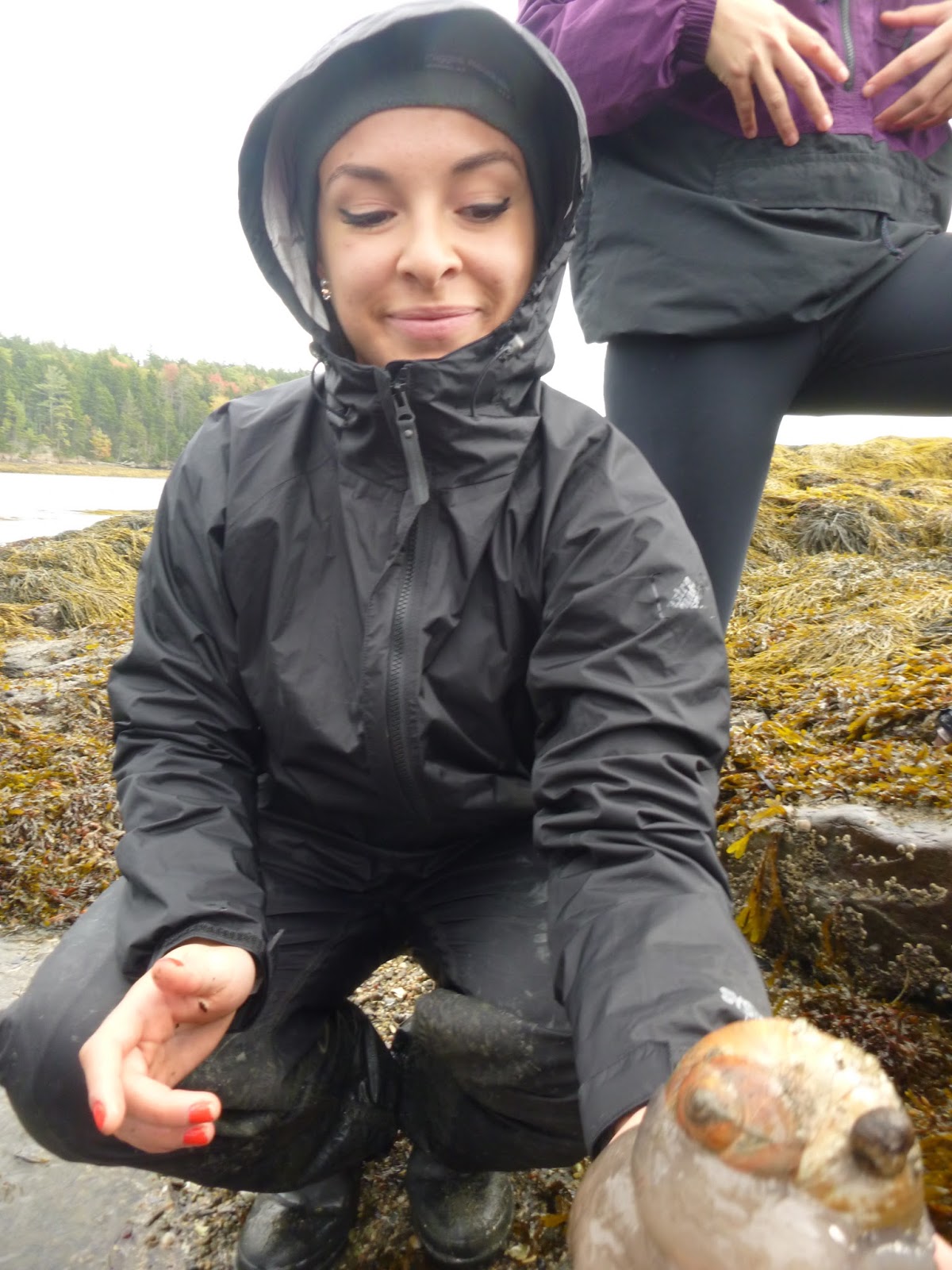
Passing one around to amaze ourselves.

This is an odd place to find two -- count 'em two -- moon snails.  Rocks?  Odd.

Brave student!

Look at that foot!

A little one!

Our cup runneth over.

She's thinking "What the . . . ?"

This is more commonly where I find them!

Sarah Kingston found this hard-shell clam with a drill hole from a moon snail!

Well, after all those moon snails, everything else might just be icing on the cake.  But really, all this stuff is amazing in and of itself.  Take a look:

Green crabs in the most beautiful shell hash colors.  What camouflage!

Loads of Mercenaria!  Quahogs or hard shell clams.

I do love a rock gunnel!

Two is even better!

Whoa!  Lady Asian shorecrab.

Peanut worms.  A big one and a baby.  Don't you dare say "ew".

Annie's not freaked out.  Why should you be?
All this bounty wasn't easily won.  We got a little stuck in the mud.  That's half the fun.

Boot stuck?  Pull it out with your hands!

Oh, I hate it when they fall.  I know what it's like.

This is why the mudflats are poorly studied.

Using a bucket for help.  Smart.

Oh, this is a serious case of mud.  Annie's in the running for a prize!
I have to thank my wonderful students letting me drag them along on my adventures.  They think I'm doing it for them!  Ha.  Seriously, they pay me for this?


Monday, October 6, 2014

What could possibly be better than this?

Yesterday, I dragged Damon to Freeport to do a little shopping.  It couldn't be helped.  There is a wedding to attend later this month, and even an Ocean Lover wants her guy to look sharp.  So we dragged the dog along, found a parking spot in the garage under the Bean outlet (lest Dory get too hot), and fought our way through the leaf-peeping shoppers to the fitting rooms.  It all worked out just fine, as Damon found two really nice pairs of LL's pants that cost a grand total of $3.76 (yes, you read that right).  What could be better than that?

Well, maybe a waterfront lunch at Piney Point.  What could be better than that?


An exploration of the dinghies next to the restaurant.  What could be better than that?


Going barefoot -- in October.  What could be better than that?


How about a big, wide, flat beach.  What could be better than that?


A dog-friendly beach?  Is this what the big deal is all about?  Nope, it gets even better.


Everything was just a prelude to a nerd's paradise: BABY MOON SNAILS. Nothing could be better than that.  Nothing.

I've written about big mamma moon snails.  They're rather extraordinary.  But never have I seen babies, and yesterday I saw not a few -- I saw hundreds.  Old Orchard Beach was rotten with them.  And they're so stinkin' cute!  With their little con-trails they leave behind, and their tiny feet bulldozing through the soft sand, and their exquisite little shells.  I mean really, what's a girl to do?


Ain't life grand?

Wednesday, October 1, 2014

Stalking Snails with Sarah

Sarah and her snails.
There's nothing better than getting paid to be at the coast.  Last week Sarah Kingston's Marine Molecular Ecology class asked for an assist in finding two types of intertidal snails -- Littorina obtusata (the smooth periwinkle), and Littorina saxatilis (the rough periwinkle).  So off to Giant Steps I went with them, back in my boots.

Intertidal snails clockwise from top left:  Littorina littorea, Nucella lapillus, Littorina obtusata, Littorina saxatilis.  Common names, respectively:  common periwinkle, dogwhelk, smooth periwinkle, rough perwinkle.

There are actually three Littorine species in Maine's rocky intertidal -- the third one being Littorina littorea, the common periwinkle.  Luckily, they have different habitats and morphologies, so telling them apart is relatively easy.

Littorina littorea is ubiquitous in the rocky intertidal, and is found from the Fucus zone down to the bottom of the intertidal zone, including in tidepools.  The common periwinkle is an invasive species that is thought to have arrived on the ballast stones of European trading vessels early in the colonial period.  These ravenous grazers feed on seaweeds, and probably have a huge effect on the rocky intertidal zone.  Interestingly, they have clear preferences for certain seaweeds, so they have changed the species composition of the habitat quite a bit.  You can identify these by their size -- they become large, perhaps an inch across, although they start as small snails so you can be confused if not careful.  The spire of their shell is pointy, and do not exhibit clear sutures between the "layers" of this whirled part of the shell.

Littorina saxatilis (the rough perwinkle) is probably my favorite intertidal snail.  It can be the hardest to find, since it is very small, and is found high above the intertidal, in the splash zone.  These are only common where there are crashing waves -- so exposed headlands are a common place to find them.  These little guys can go many days without being wet, and have almost lung-like organs.  They feed on the black Calothrix (the slick blue-green algae you can find at the top of the intertidal zone).

Hundreds of rough periwinkles hiding in a crack at Pemaquid Point.

"Halos" of Calothrix algae around the cracks where rough perwinkles hide.  They come out of the cracks when it's wet and cool to feed, then return to the cracks when it's dry and hot (to get some relief from the heat).
Littorina obtusata (the smooth periwinkle) is the jewel of the intertidal.  Relying exclusively on knotted wrack (Ascophyllum nodosum) for habitat and food, this snail  mimics the colors of this beautiful algae -- yellow, orange, green, brown, and even red.  They can be tough to find because they are so well camouflaged.

Typical habitat of the smooth periwinkle.
Our mission was to find about 40 individuals of both rough and smooth periwinkles, so Sarah's class can study their genetics.  The first place we looked was in the knotted wrack, and it wasn't long before the first "I found one!" was heard.  Once people got the search image in their heads, we found our quota pretty quickly.  Then it was on to the exposed rocks at the southern end of Giant Steps (where we were very careful).  We had a great look around, then got to work looking in the crevices at the top of the intertidal zone.  Thousands of tiny rough periwinkles were hiding there, so we quickly hauled in our snails.  Not a bad way to spend a Friday afternoon, and I didn't even have to go to the probability lecture that the students sat through after our intertidal adventure!

Found one!
Maybe I got a bit distracted by the anemones in the tidepools at Giant Steps . . . .
A box full of snails.
Aha!  They thought they could hide from me.  No way.
These are dogwhelks -- predatory snails also found in the intertidal zone.  They're eating these barnacles.
Hunting for rough periwinkles.
Checking out our haul.
A photo for Facebook?

Wednesday, September 24, 2014

Sometimes, Nostalgia: Woods Hole

Years ago, before we were married, Damon had the good fortune to live and work in Woods Hole.  I was in Boston at the time, working at the New England Aquarium.  My department was undergoing some turmoil, and I was asked to be the interim Curator of Education during a time of hardship and change.  What I did, mostly, was prevent anyone from being laid off before our next curator could be hired.  I had a lot of responsibility, and no authority.  In short, it sucked, although I worked with some of the most amazing people I will ever know. Oh, and at the same time, I was starting a Master's degree at Harvard.  There was no rest for the weary.

But there was Woods Hole.  Every Friday evening, I'd hustle down to South Station and catch the commuter bus.  That was the moment I felt free and lighthearted.  I'd roll into Woods Hole at around seven, and for the next 48 hours, we'd cook great meals of cheap mussels, explore the Cape, and have beers at the Captain Kidd.  There were dances in the fire hall, and dinners with other young scientists, the dog parade, and the ferry horns waking us every morning.  We'd walk up to Nobska Light and watch the sunset.  Damon was working for the marine mammal acoustics lab, for Bill Watkins, one of the grandfathers of the field.  Bill was a great boss, and as Damon says, everything he learned about good bosses, he learned from Bill.  Damon took full advantage of all Woods Hole had to offer -- talks, and camaraderie, and the chance to stand on the shoulders of giants.

They were great years, and it was a fine time to be young and in love.  We got engaged and held our wedding on the Quisset campus of the Woods Hole Oceanographic Institution -- where they charged us a whopping $100 for renting the space.  But careers took us away from Boston and Woods Hole.  Damon was invited to pursue a PhD at Duke, and I finished my Masters in Math and Science Education, then decided it'd be fun to spend some time in the classroom.  We did what people do -- move on, to bigger and better things (mostly).  Deep in my heart though, I will always have a soft spot for Woods Hole.

Last weekend, we headed down to Woods Hole for the Organization of Biological Field Station conference.  We drove down with some colleagues, one of whom had worked in Woods Hole for quite a few years.  As we drove along Woods Hole Road from Falmouth, the three of us had a little nostalgia fest.  "Oh, there's the bike path!"  "That's where the Sea Education Association has it's headquarters!"  "Ah, we got married right there!"  "Oh, I used to eat at that restaurant all the time!"  We were glowing with happiness.  Our friend who'd never been to Woods Hole pretty much rolled his eyes at our sentimentalism, but asked me a great question -- what's so great about Woods Hole?

This is what's so great about Woods Hole:

Science.  BIG science.  This is a place where intellectual curiosity meets practical engineering, and Woods Hole has a critical mass of people, stuff, and money to ask some pretty amazing questions.  

We went on a field trip to the Waquoit Bay National Estuarine Research Reserve, where the staff took us out to their study site where they are measuring how greenhouse gases interact with salt marshes.  That walkway might not look like much, but it's a clever way to minimize the impact of humans walking all over the study site, maximize the amount of sun reaching marsh plants on the path, and move really expensive pieces of equipment -- like $100,000 mass spectrometers -- out into the field.


History.  You can feel it, everywhere you turn.

Rachel Carson, amongst other greats, spent time here.  She still sits on the waterfront, and you can sit down and have a good think alongside her.  I recommend it.


Although I simply love Rachel, I can't forget good old Louis Agassiz.  Agassiz was one of the great scientists of the 1800's, with a passion for natural history.  He was a professor at Harvard, and the founder of its Museum of Comparative Zoology -- one of the premier science institutions of its time.  He also founded the precursor to the Marine Biological Laboratory, thus is considered on of the grandfathers of field study.  He had strong opinions about education and research, and was known to shut students into a room with specimens and not let them out until they had "discovered all the truths which the objects contained".  In short he was a formidable educator and scientist.

Now, I can't praise Agassiz for his brilliance without pointing out his flaws:  Agassiz resisted Darwin's work, and turned out to have a racist streak in him that was manifested in his belief in polygenism, the belief that the races were created separately.  Maybe he was simply a product of his time and class, but we can't forget Agassiz was wrong about many things.

This quote of the great man, hanging in the library of the Marine Biological Laboratory, has inspired generations of scientists, and is excellent advice even today:

A like-minded community.  

Where else would the bells of the Catholic Church be named after scientists? Thanks be to God, for sure.


The Eel Pond.

The heart of Woods Hole is the Eel Pond, surrounded by academic labs and old New England cottages, filled with sailboats and interesting sea life, and spanned by the drawbridge.


A sense of humor.

Even the graffiti is about science.  These are from courses at the Marine Biological Laboratory, and highlight "Neuro" -- note the neuron, "Embryo" -- with the cute little embryo, and CSS -- the Children's Science School, which turned 100 last year.


Classic old buildings and art.


Some really great food, shared with some really great people.


Alas, I am home now, a bit sad to drive away from Woods Hole once again.  I didn't cry for hours, as I did in 1997, nor do I have the radio stations of that area (WMVY) programmed on my car radio, refusing to take the preset off for a year.  (Of course, now I can listen to it online, and I recommend WMVY to you all.)  A little part of me wants those years back, though.

I tell you all -- get thee to Woods Hole.  Spend a day or a lifetime.  Let your curiosity take you where it will.  If you're like so many of us, it will take you to great places.