Showing posts with label Fish. Show all posts

Monday, May 5, 2014

Alewife Rescue Squad

A proverb:

Under a hot summer sun, the beach is strewn with seastars stranded by the tide.  Soon, they will die from the heat.  A boy starts at one end of the beach, and slowly but surely moves one seastar at a time back to the water.  A man watches him, unimpressed.  As the boy picks up yet another seastar, the man walk up to him and says "Why are you wasting your time, boy?  You can't possibly save all these seastars.  All your work won't make any difference because most of them will die anyways."  The boy, wise beyond his years and still fresh with optimism, replies "Maybe I can't save them all, but to this particular seastar, I'm making all the difference in the world."

In the face of all the environmental problems of our day and age, this is a great lesson to us. Small actions can make a big difference, if we all make good decisions.  And last Saturday, I saw the proverb in action.

We were down in Massachusetts, so Damon could run a road race on Saturday, and I could run my marathon Sunday.  Between the two races, we did a bit of exploring.  Southeastern Mass is near and dear to our hearts, as we both lived there for a time (and in fact met there!).  We were driving through Middleborough, and passed Oliver Mill Park, where long ago I'd seen my first American eel.  It was a gorgeous day; the sun was out; and it felt like the start to a nice warm stretch.  "Wanna check it out?' asked Damon, noting the many cars in the parking lot.

"Sure," I replied. Is he kidding?  Besides, the dog loves a good walk.

The park on the Nemasket River is the site of an old mill, so common in this part of our country.  These mills brought prosperity to New England, but they also devastated the anadromous fish that plied coastal rivers for millenia.  Often, no provision was made for fish to pass upstream and downstream, so they had no way to reproduce and died out quickly.  Some mills put in fish ladders, some of which were successful in making passage possible, some of which were poorly engineered and did little good.


This site has an amazing fish ladder, with water cascading down a series of steps that fish can shoot up and over.  The water's been very cold in Maine, pushing the migration back*, but in Mass, the water was thick with alewives.  We stood transfixed, watching small schools of fish climb each rung.  Once they were over the ladder, they shot upstream.  Below the dam, there were plenty of gulls waiting for a shot at some protein, as is typical at fish ladders up and down the coast.


The fish ladder, which was teeming with alewives.
Gulls below the dam, waiting for a meal.
Along with the fish ladder, the park has the remnants of dams from its industrial past.  These are impassable for fish, but they don't know it.  They gather below the dams, rushing as far as they can upstream, only to be tossed and tumbled in the rapids under the dam.  These are the lost souls of the alewives, who aren't likely to join their counterparts upstream.

Can you see them all in there?  They'd never get over that dam without help!
The day we visited, though, a good Samaritan was watching over some of these lost fish.  Pants rolled up, barefoot, a boy was standing below the dam, searching through the waters with his hands, looking for fish in need of a boost.  It was tough work, and he struggled to keep his foot hold in the rushing water.  But he was successful -- every once in a while, he'd pull out a fish and toss it over the dam.  He had an audience, and with each fish, they'd applaud and cheer.  His enthusiasm was contagious, and soon he had his little brother helping out, and eventually some adults just had to get in and get their hands on some fish.  Maybe they only helped a dozen or so fish.  Not much in the grand scheme of things, it might not seem like much.  But it was enough to make all the difference in the world for those particular fish.

Searching for herring.

The audience waits with baited breath.

Success!  Nice job.

The grownups can't resist.  Notice the fish tumbling in the backwash.

The herring rescue team deploys.

More luck!

Swim little fishies!  Swim if you can -- and they swam and they swam right over the dam!

* I just learned they're here!  Today's my day to go count too!  Woohoo!

Thursday, March 20, 2014

Who wants to be a marine biologist?

Wanna try your hand at science?  Help out a land trust (the Ocean Lover's favorite type of non-profit)? Spend a few hours outside?  What's that?  YOU want to do it?

Great!  Because despite current conditions and indications to the contrary, the earth is moving around the sun, our hemisphere is starting to get more direct radiation, and spring is about to arrive (gal-dangit, it better). With it will come some of the greatest migrations on earth -- whales (from as far as the Caribbean), sandpipers (passing through as they fly from South America to the Arctic tundra), and the anadromous fish that live in Maine's fresh waters for part of their lives.  This is National Geo worthy -- and you can have a front row seat.

The Kennebec Estuary Land Trust (KELT), has protected almost 1000 acres on the Midcoast, and they want you.  KELT worked with the Bath Water District starting in 2010 to restore the fish ladder from the Kennebec via Nequasset Brook to Nequasset Lake, prime spawning habitat for alewives. Later this year, the ladder is getting a major refit, expected to make passage for fish easier and maintenance of the ladder less labor intensive.  Every year, KELT recruits dozens of volunteers to count how many alewives climb the ladder.

Swimming upstream!  Gotta make me some babies!  Credit: Jerry Prezioso, NEFSC/NOAA
I'm psyched to help out.  Volunteering involves choosing a 2 hour shift, and within that 2 hours, doing two 10 minute counts of fish, as well as collecting associated data such as temperature and the presence of predators (if you're a bird watcher, this part will thrill you).

Alewives were part of the enormous biomass our ancestors found when they arrived in Maine.  Every river would have been jam-packed with alewives in spring, as they ran up the rivers to spawn.  Any number of species relied on this bolus of protein during the migration -- gulls, ospreys, and eagles; raccoon, fox and turtles; and marine predators like cod and even whales.  (Dogs?  Probably.)  People relied on the alewife run too -- smoked alewives were an important source of nutrition (especially for the poor), and they were commonly used as bait for lobstering.  Everything eats alewives.  Everything.

Unfortunately, most of the alewife runs in Maine are a shadow of their former self.  Dams have blocked passage of alewives (and many other anadromous fish) along almost all of Maine's rivers. But this is a new era.  Recent efforts to eliminate barriers to fish passage have succeeded in opening the St Croix watershed (where the alewife run was reduced to just 900 fish at one point) and much of the Kennebec, plus smaller watersheds around the state -- like the Nequasset Dam.  It's an exciting time to be an alewife!

I know you're chomping at the bit to sign up to volunteer -- aren't you?  How can you resist?  Go to the KELT website and follow the link for the 2014 Fish Count.  Mark it on your calendar and dream about being out in the spring sun cheering these small heroes on their way up the ladder.  Maybe I'll see you there.


*Want to see alewives but don't think you can volunteer?  There are two other great places to see them. The Damariscotta Mills fish ladder is probably the most amazing place (going to their Alewife Festival on Memorial Day weekend will make it even more fun), and you can check out the fish ladder at the Brunswick Hydro Dam (on the Androscoggin).  Alewives start running when the water reaches 57 degrees, so May is probably a good time to visit.


Monday, September 30, 2013

Basking shark tag recovery


Andrew Westgate, wandering tag in hand.

Last week, an old friend emailed an offer I couldn't refuse.  A basking shark (Cetorhinus maximus) tagged off Grand Manan in the Bay of Fundy, had gone on walkabout.  The pop up tag, designed to float free after a few days recording the shark's behavior, was phoning home.  Andrew Westgate, from UNCW and the Grand Manan Whale and Seabird Research Station, was on a quest to get it back.  And I got to ride along.  (Dory stayed at the doggy hotel, having her spots polished, as Damon likes to say.  He was at Kent Island.)

Basking sharks, bizarre and extraordinary, are the second largest fish on the planet.  And they grow to such great lengths -- 40 feet -- not through spectacular and gruesome acts of predation, but through filter feeding.  The "basking" in basking shark comes from their habit of spending so much time on the surface (Andrew's tags indicate they can spend as much as 40% of their time there) and the leisurely pace of their swimming.  In the Gulf of Maine, basking sharks concentrate there foraging on Copepoda, using modifications to their gills called rakers.  (Want to see more?  Check out this nice documentary.)

In an apparent case of convergent evolution, basking sharks are remarkably similar to right whales.  (Which gets me wondering what mechanism prevents them from competing for the same niche while they are in the Gulf of Maine.)  Both are ponderously large, slow-moving, surface dwelling plankton eaters.  It's no surprise, then, that basking sharks face many of the same threats as right whales:  over exploitation, entanglement in surface fishing gear, and ship strikes.  So learning more about their behavior is an important step towards conservation of the species.  

Andrew's group started researching basking sharks in the Bay of Fundy in 2008; deploying tags that record behavior on a short time scale; other tags that record location over several months; and conducting aerial surveys in the Gulf of Maine.  They also are assembling a photo-id catalog of dorsal fins, because it turns out you can track an individual over time through the unique fins (as you can bottlenose dolphins by they fins, or humpback whales by their flukes).

The tag we were hunting for was floating some 40+ miles southeast of Mount Desert Island, sending its location up to satellites.  Andrew chartered Osprey, the College of the Atlantic's outstanding new research and teaching vessel, to go after it.  We lucked out with the weather -- a late September's day was never so fair as last Saturday:  70 degrees and northwest winds 0 - 5 knots.  It wasn't quite a Beaufort 0, but it was close -- nearly flat calm.  We left Bar Harbor under the shadow of two enormous cruise ships and headed out past the cliffs of Acadia.  Lobster bouys peppered the water until we reached Mt Desert Rock, where they slowly petered out.  Cadillac Mountain, a looming monster on land, grew smaller and smaller, then was no more.  Herring gulls grew less common and pelagic birds flew by to check us out.

College of the Atlantic's amazing research and education vessel.


Osprey's crew.


Andrew and Captain Toby Stephenson discuss the plan of action.
It might seem like finding a tag the size of a cucumber would be the proverbial needle in the haystack, but we found the tag with no problem.  A couple of miles from where we expected to find the tag, Andrew donned his headphones and tracking gear to pick up the radio signals the tag was emitting.  He was able to pick up a good signal and point the boat towards the tag, which we simply scooped up with a net.  (The tag was entrained in a raft of seaweed, just as Andrew said it would be.)  I'm sure it was a moment of relief for Andrew when we brought it aboard.  He never expected a shark would carry it so far offshore or so far from home.

Andrew listening for radio signals with a "yagi" antenna.


Quarry captured.  Phew.


Explaining how the tag works.


I'd call, wouldn't you?
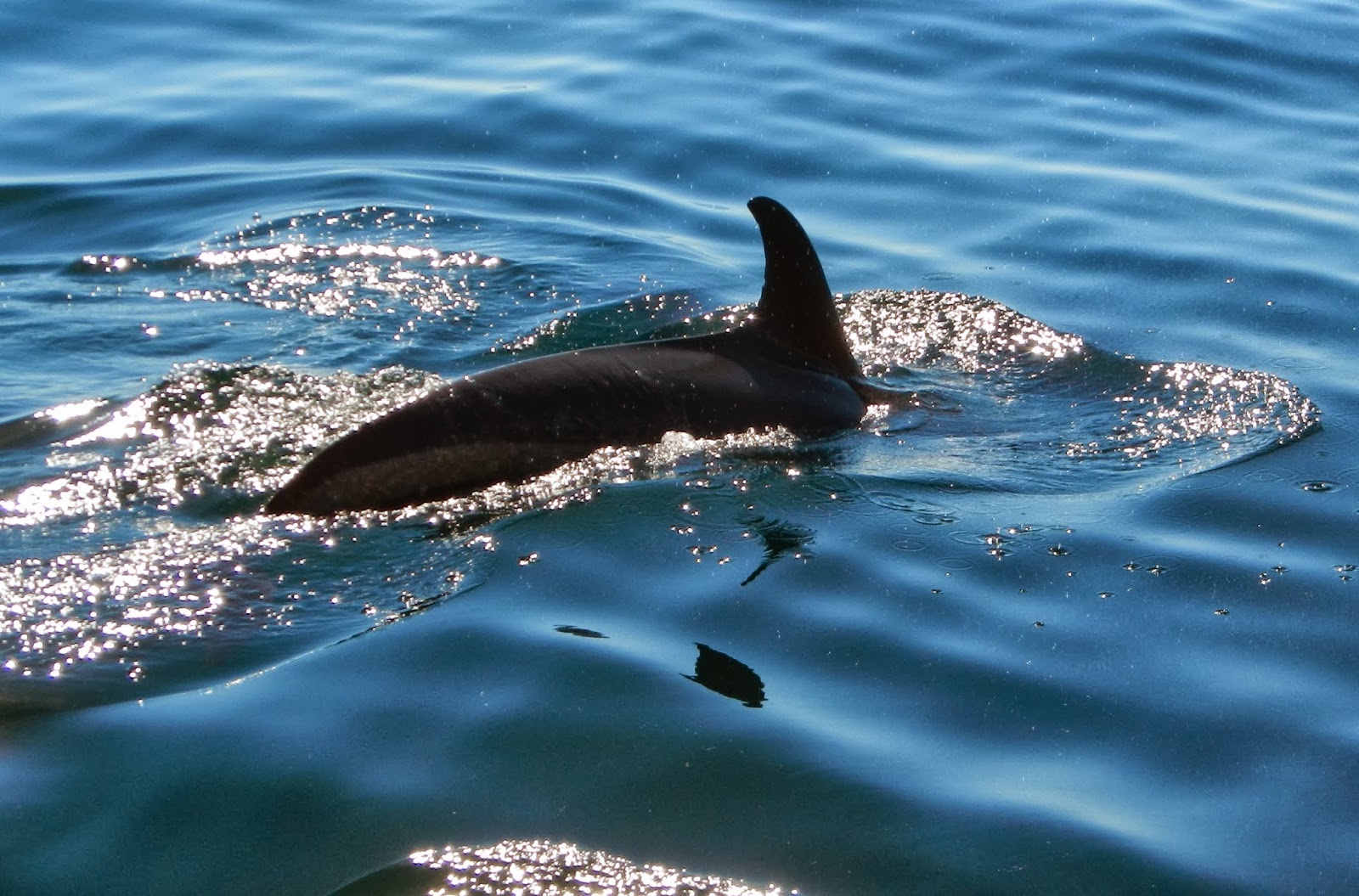
 Beyond the tag, it was a spectacular day for wildlife.  Humpback whales, white-sided dolphins, pilot whales, two -- yes two -- encounters with Mola molas, and a blue shark.  I rarely get to head so far offshore, and never on such a nice day.  With the seas so calm, we could see disturbance on the water far in the distance -- a hint that wildlife was probably there.  One of the pleasures of the day was spending time with a crew who was as fascinated by the animals we encountered as we were.  Any little hint of a whale sent us off to investigate.  Osprey was a sweet ride with a terrific crew.

Taking photos of humpback flukes for photo id.


Looking the fluke catalog to determine who it was.


Pilot whales.

Atlantic white-sided dolphins.

Mola mola!  MOLA MOLA!


One of our humpbacks.
 Alas, it had to end.  We steamed into Bar Harbor (past an enormous cruise ship on its way out) just as the sun was falling behind Cadillac Mountain.  It was a satisfying day all around -- tag recovery, amazing wildlife, and a visit with an old friend.  Any other old friends want to let me "tag along" -- just call me.  I'll drop my grading and be right there.

Tourists on a sunset cruise.

Friday, September 13, 2013

Mola mola!

In July, I took an advanced sailing course through Women Under Sail.  Mid morning on our first day we were sailing east  in Casco Bay just off the tip of Bailey's Island, when Jane Parker, the First Mate, cried "A porpoise!  Oh!  It looks like it's in trouble!  What's wrong with it?"

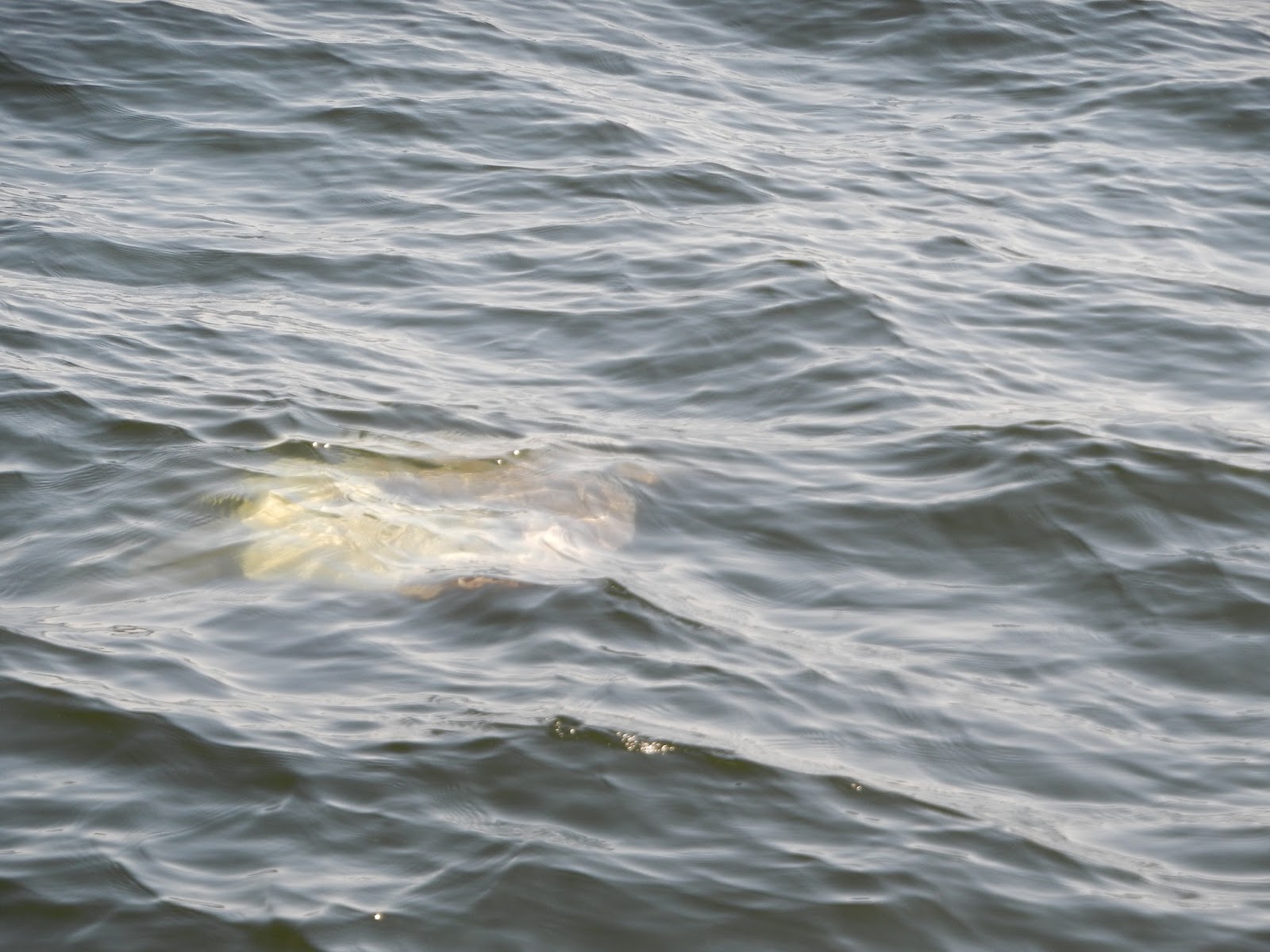
A poor photo of Mr. mola

If you look carefully, you can see his little mouth!
What's wrong with it was it wasn't a porpoise at all.  It was a Mola mola, or ocean sunfish.

Now, I have a thing for Mola molas.  Even their name is awesome.  (Their name in German, Schwimmender kopf, swimming head, is even more awesome.)  So I had a little fit when I got up from the cockpit and realized what we were seeing.

"OH MY GOD THAT'S NOT A PORPOISE IT'S A MOLA MOLA!"  

(Jane Parker reenacted my reaction several times during the course, just to remind me how geeky I am.)

There it was, a Mola mola sunning itself along the surface of the Gulf of Maine.  Molas are gigantic -- the largest bony fishes known, reaching 5000 pounds and 10 feet long.  Their German name -- swimming head -- is appropriate, as they have no "tail", just a big body with large dorsal and ventral fins they use to propel themselves through the water.  For a long time molas were thought to feed exclusively on jellies (from looking at their stomach contents), but recent evidence suggests their diet may be more varied.  Molas are considered plankton -- they can't swim effectively against currents, so drift through the oceans.  

Bigelow and Shroeder, in their seminal work Fishes of the Gulf of Maine (written in 1948), had this to say about the mola"When these unlucky vagrants are sighted in our cool northern waters they have usually been chilled into partial insensibility. They float awash on the surface, feebly fanning with one or the other fin, the personification of helplessness." But it's likely that molas are more than occasional visitors in summer, and that their visits are due to more than chance.  Molas may come north in warm months to take advantage of the high concentrations of jellies, but head south with the onset of autumn.  Potter and Howell recently published this paper on satellite tagging of molas, and they found the molas they tagged in New England moved south for the winter, some all the way to the Gulf of Mexico.  They also found evidence that what we think of as "basking" -- lying on the surface of the water -- may not have anything to do with sunbathing.  Molas didn't bask more in cold water than warm.  That leaves us with the question of just what are they doing?  (Posing for a photo?)

No doubt, I'll be watching for my next encounter with Mola mola -- my favorite fish. Unfortunately, it was hard to get decent photos under the conditions.  Sailing along on a giant boat that's hard to maneuver isn't the way to take amazing photos of the sea.  We came about several times and got a good look, then went on our way (to Damariscove Island, a story for another day).  It was a real highlight of the trip and shows you never know what you're going to see out there.

So keep your eyes open.


Jane Parker, best First Mate ever.