Showing posts with label Sailing. Show all posts

Sunday, February 28, 2016

Making a Name for Ourselves


Super shiny.  Super expensive.  Walk away  Damon, WALK AWAY!
Yes, I know, I know.  It's been a long time since I posted.  What can I say -- it's winter and we've had a ton of stuff happening in our life.  A ton.  More on that later, let's talk ocean.  Or at least let's talk boat.

Last weekend we shot down to Boston for the New England Boat Show.  NEBS doesn't have the appeal of the Newport Boat Show, or Strictly Sail down in St Pete.  It has a ton of little run-abouts, it's inside, and there aren't that many sailboats.  But it comes at just the right time -- February, when we're just about done with winter, both literally and figuratively.  We thought it'd be a great time to look for all the "stuff" we need as we refit Fulmar for her first sailing season with us.  We're looking at dropping several thousand dollars on the basics, so why not see what kind of deals we can get?

My this is a calm anchorage!

Indoor sailing in February.
We climbed up on a bunch of fancypants boats and talked to a ton of people about boat slips and batteries and insurance.  Then we found the good folks at New England Lettering, which is fortuitous, as we need to change the name on the boat. Fulmar is a "documented boat," meaning she doesn't have state registration numbers, instead she has a federal registration.  We have to have her name and hailing port clearly identified on her at all times, plus her documentation number permanently affixed to her someplace down below.  We finally just got our title from the Coast Guard, with a stern statement telling us there is a $10000 fine for not properly identifying your boat, so we were motivated to get that name sign made.

Designing the lettering.  So many options.
We were able to design the name and home port right at the booth, and just as quick as you could swipe a Visa card, the vinyl lettering was being cut on their nifty little machine.  These guys are good; obviously this is something they can do in their sleep.


Super pretty!  Fulmar is going to feel like a new girl!

Putting the backing on.

Ready to apply to the boat!  Now we just need to get those old letter off . . . .
So the sailing season grows nearer, and things get more and more real!

Sunday, August 23, 2015

Tails it is . . . .

Here's how to name a boat:

Step 1:  Sell your house.  Everyone (and by everyone I mean Damon and I) knows it's a PITA to take care of both a house and a boat.

Step 2:  Buy a tiny, cute condo.

Step 3:  Ignore the fact that you still have to move all your stuff out of storage and into the condo. Instead, go boat shopping.  Pick about a dozen boats that look likely and start calling brokers and private sellers.

Step 4:  Find a boat.  Make sure it's not too big, or too small, or too expensive, or in too bad a condition.  Find one that's just right, like this one:


Step 5:  Call a marine documentation company who will change the Coast Guard documentation from the old owner to the new (that's you).  Have a small epileptic fit when they ask what the new name of the boat will be.  Tell them you haven't yet made that decision, cripes, deciding to buy the boat was hard enough.

Step 6:  Get out a sheet of paper, a pen, and a few bottles of wine.  Start generating ideas for a name. Do not drink the wine too fast or you will end up with a bad name, such as "Seas the Day" or "Black Pearl".  Apparently this happens because there are 177 "Seas the Day"s and 175 "Black Pearl"s in the Coast Guard Registry, and that's only for big boats.  Imagine all the little flats boats and day sailors out there sporting such names.  I kid you not.  And NO use of the term "knot" in the name.  Waaaay too corny.  If there must be a pun, please, make it clever.  (Apologies if your boat has one of these names, but you really should have read this before diving in!)

Step 7:  Do not try to google "good boat names".  Here are the top 10 boat names from 2014, which will tell you most boat names are not good:

1. Serenity
2. Second Wind
3. Island Girl
4. Freedom
5. Pura Vida
6. Andiamo
7. Island Time
8. Irish Wake
9. Happy Hours
10. Seas the Day (there it is again)

Clearly the internet is no help whatsoever.

Step 8:  Once you have about 20 names, start to look at each carefully.  Make sure they don't sound like something they're not.  Like "petrel", which was a candidate on our list.  A petrel is an elegant little seabird (probably the most common in the world) that happens to nest on Kent Island, so we have a soft spot for them.  But "petrel" sounds an awful lot like "petrol", which is what many people in the nether regions of the world call gasoline.  Cross that one off the list.  Then make sure they pass the radio test.  When hailing a boat over the radio, the convention is to say their name three times, then say yours.  As in "Seas the Day, Seas the Day, Seas the Day, this is Black Pearl on channel 16". Whatever name you choose should be easy to say and easy to understand.  No tongue twisters are allowed.  Like Toy Boat.  Try saying that three times.

Step 9:  Cross off any names either of you hates.  Be nice though.

Step 10:  Each of you choose your top five.  Don't show each other what you chose until you are both done.  Eliminate any not on both your lists.

Step 11:  At this point, person one (Janet) should say "I like any of those, you choose." Person two, Damon, should respond "No, I like all of them.  You choose." Refuse to take responsibility.

Step 12:  Refill wine glasses, it's gonna be a long night.

At this point in the game, Damon and I had the list down to two candidates; Phalarope and Mercator. A Phalarope is a dainty little shore bird with a wicked cool name, and Mercator was a mathematician from the 16th century who invented a way to draw charts that allowed sailors to steer a compass course (as in, for centuries he's been safely guiding sailors between safe harbors, pretty cool).  There was much hemming and hawing.

Step 13:  At the last moment, have a flash of inspiration and add a write-in candidate.  This is what Damon did -- he threw in a zinger at the end;  Fulmar.  A fulmar is closely related to petrels (and shearwaters, another possible name we crossed off the list).  As one of Damon's friends says, "they are the sexy birds" (ignoring the vomit part of their biology).

We decided we liked Fulmar better than Phalarope.  But Fulmar and Mercator were still in a dead heat.  It was time to bring out the big guns:

Step 14:  Flip a coin.

"Your call," Damon said, his eyes blazing at me over the quarter in his outstretched hand.

"Okay.  Heads, Mercator, since he had a head.  Tails, Fulmar, they have tails."  

"Here goes . . . tails it is.  Fulmar."

And that's how you name a boat.

(It's a well-known fact that it's bad luck to rename a boat, unless there is a boat renaming ceremony. This involves making offerings of rum to Neptune, and some level of imbibing said rum.  Count me in.)

In case you're wondering:

Fulmar, as she will be known, is a 1982 Pacific Seacraft Crealock 37.  We have a survey scheduled for next Tuesday, and if all goes well, will take possession of her in the near future.  Fair winds!

Wednesday, July 15, 2015

Being and Doing, rather than Having

The American Dream isn't always straightforward.  The idea of owning a big house with a picket fence, a huge green lawn, and two cars in the garage has never been particularly attractive to Damon and I.  And since Damon's little incident, we've become even less enamored with owning the American Dream and all the stuff that comes along with it.  

It was a nice house, wasn't it?
Our disinterest in home ownership turned into action last year, as we sat in an Italian restaurant staring at each other over our pasta.  I'd just run a marathon (literally; the sweat wasn't even dry).  We'd also just found the perfect boat, at a very reasonable price.  But we couldn't pull the trigger on buying it, try as we might to convince ourselves as we slurped up our noodles (well, Damon was done eating well before I was, so I slurped and he watched).  That was both a terrible day, and a terrific day.  A turning point.

I keep a folder on my browser at work with boats we might want to look at.  Sailboats; all between 35 and 40 feet, in our price range, capable of blue water cruising.  Some are pipe dreams, but most are boats we can afford when we feel like it's time.  I click on this folder once a day and choose "open all tabs"; checking to see if any have dropped in price to the point where they should be moved up the list to the top.

Last May, the Friday before I was to run my third marathon, I was getting antsy as I waited for Damon to finish his work so we could load up the car and get down to Providence for the pre-race activities.  I waited and waited.  I cleaned my lab.  I graded a few papers.  And I opened that folder one more time.

A boat we'd been considering, a Pacific Seacraft 37, had dropped drastically in price just that afternoon, and suddenly it wasn't just a good deal -- it seemed to be a great deal.  I was out of my office and at Damon's desk in a minute.  He tore himself away from the all-important email he was composing, checked out the listing, we looked at each other with stupid grins on our faces, and he called the broker right away.  Was there something wrong with the boat making the price drop so much?  No, it was an estate sale and the family just needed to get rid of the boat.  Was he available to show it this weekend?  Sure, Sunday would be great.  In the afternoon.  Right after I ran 26.2 miles.

I crossed the finish line at around noon; tired and cramped after a particularly difficult morning (I had to walk about 2 miles of the race; disappointing but not devastating).  I found Damon, cried on his shoulder for a minute, and told him to stop me if I ever suggested I wanted to run another marathon.  He laughed; I say this every time.  He pushed a turkey sandwich into my right hand and a candy bar into the other, and we set off towards Boston and this interesting boat.  Along the way I stripped out of my sopping clothes and into something more acceptable (not so easy in the front seat of the mighty Kia as we sped along I-95).

The boat was indeed a good boat.  It was in relatively good condition; it needed one major repair, but otherwise seemed a perfect fit for our needs.  It was a great size; it had a nice layout; it was well outfitted.  We poked around all the lockers and made small talk with the broker.  Another couple stormed around the boat finding (unfounded) fault with everything in an attempt to make the broker think a lowball offer was reasonable.  One of our rules is to NEVER say bad things about a boat in front of its owner or broker.  Ever.  Your job is to make them like you; to sell yourself; especially if multiple bids will be coming on the boat.  This is the guy (or gal) who has the power to make your dreams come true; don't piss him off.  The broker rolled his eyes at these jerks, and basically told us if we made an offer anywhere near asking price, the boat was ours.

Whoa.  We'd talked about buying our "forever boat" for, well, ever.  We'd saved our pennies.  We'd sold our little boat.  We'd looked into where we were going to put it and where we were going to go in it.  And here it was, knocking on our door.

But there was a catch.  We weren't as ready as we thought we were, now that the moment had arrived.  As we sat eating pasta, we realized what a stretch it would be to own both a big house and a big boat.  We were already struggling to take care of the house, given our summer schedule.  Each year, we get back from Kent Island in late July and realize we have to replace that trim, paint that siding, rebuild that deck rail; you name it, it has to be done in August, because as they say in Westeros, Winter is Coming.  And if we bought a boat, that simply wouldn't get done.  Either the boat would go unused, or the house would fall into disrepair.  And so we stared at each other, struggling with the idea of letting this perfect boat pass us by.

That was a painful moment, but also a wonderful moment.  That was the very moment we decided to get off our cans and sell the house.  That house was nice, but it was keeping us from doing what we love, and besides, it was clownishly large.  Four bedrooms?  For two people?  What?  It was intimidating thinking about all the work that had to be done.  The fixing, the painting, the decluttering.  But we did it.  We fixed the banister that'd been loose for over a year.  We painted the dining room. We installed a new counter, sink, and fancypants faucet in the kitchen (and painted the walls and cabinets for good measure).  We spent spring break cleaning out the basement.  Had yard sales and went to Goodwill and made not a few trips to the dump.  We shampooed the rug and cleaned the windows and bought new bedding.  We trimmed the bushes and raked and generally made the place look awesome.

And then we called a realtor.

And a week later, sold the house.

Of course, we need a place to live.  But we wanted to make sure our next place wasn't going own us -- we wanted something small and easy to maintain.  For us, the solution was a tiny, funky condo, just over a mile from work.  It's in an old farmhouse; it's just two bedrooms, and it's small.  Really small.  This has several benefits.  Not only do we not need to take care of the outside of it, the inside is so small it will be easy to maintain.  And of course, it's a lot cheaper than a big house to have.

The old farmhouse our condo is in.  We're the bottom floor, right side of the blue door.
 There are downsides, but all of this is helping us to BE and DO, not HAVE.  Like so many Americans right now, we're realizing that you don't own a house -- a house owns you.  This is our attempt to free ourselves from being owned by our stuff.  This place is so small, there's not a lot of stuff around to own us anyways.  And for an Ocean Lover, this is a good thing.  We'll have more time to explore the ocean and more time to write about it.  Maybe even more time (and money!) to buy that perfect boat next time it falls into our lap.

The kitchen.

The living room.

The view from my walk to work.

Friday, September 13, 2013

Mola mola!

In July, I took an advanced sailing course through Women Under Sail.  Mid morning on our first day we were sailing east  in Casco Bay just off the tip of Bailey's Island, when Jane Parker, the First Mate, cried "A porpoise!  Oh!  It looks like it's in trouble!  What's wrong with it?"

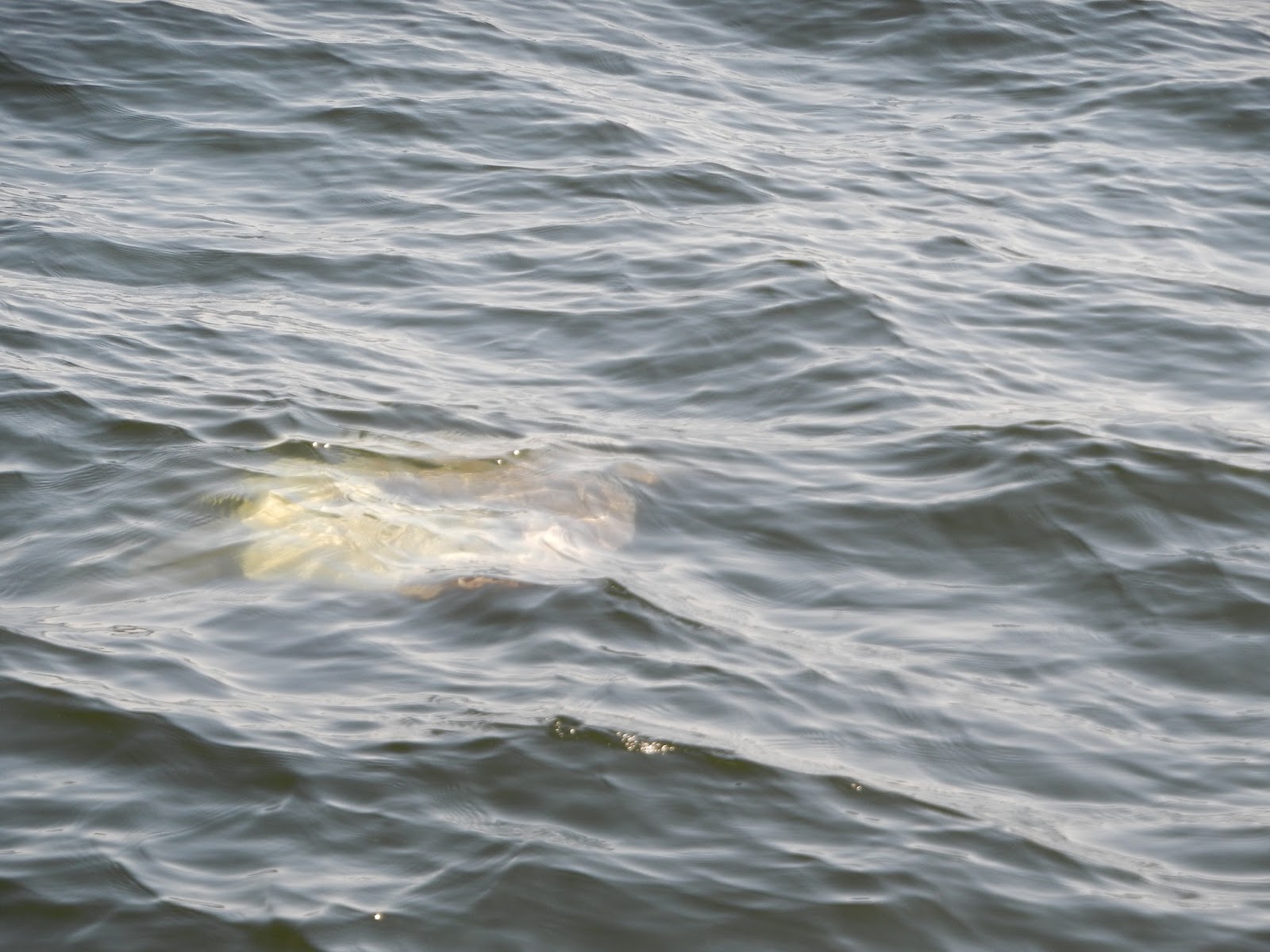
A poor photo of Mr. mola

If you look carefully, you can see his little mouth!
What's wrong with it was it wasn't a porpoise at all.  It was a Mola mola, or ocean sunfish.

Now, I have a thing for Mola molas.  Even their name is awesome.  (Their name in German, Schwimmender kopf, swimming head, is even more awesome.)  So I had a little fit when I got up from the cockpit and realized what we were seeing.

"OH MY GOD THAT'S NOT A PORPOISE IT'S A MOLA MOLA!"  

(Jane Parker reenacted my reaction several times during the course, just to remind me how geeky I am.)

There it was, a Mola mola sunning itself along the surface of the Gulf of Maine.  Molas are gigantic -- the largest bony fishes known, reaching 5000 pounds and 10 feet long.  Their German name -- swimming head -- is appropriate, as they have no "tail", just a big body with large dorsal and ventral fins they use to propel themselves through the water.  For a long time molas were thought to feed exclusively on jellies (from looking at their stomach contents), but recent evidence suggests their diet may be more varied.  Molas are considered plankton -- they can't swim effectively against currents, so drift through the oceans.  

Bigelow and Shroeder, in their seminal work Fishes of the Gulf of Maine (written in 1948), had this to say about the mola"When these unlucky vagrants are sighted in our cool northern waters they have usually been chilled into partial insensibility. They float awash on the surface, feebly fanning with one or the other fin, the personification of helplessness." But it's likely that molas are more than occasional visitors in summer, and that their visits are due to more than chance.  Molas may come north in warm months to take advantage of the high concentrations of jellies, but head south with the onset of autumn.  Potter and Howell recently published this paper on satellite tagging of molas, and they found the molas they tagged in New England moved south for the winter, some all the way to the Gulf of Mexico.  They also found evidence that what we think of as "basking" -- lying on the surface of the water -- may not have anything to do with sunbathing.  Molas didn't bask more in cold water than warm.  That leaves us with the question of just what are they doing?  (Posing for a photo?)

No doubt, I'll be watching for my next encounter with Mola mola -- my favorite fish. Unfortunately, it was hard to get decent photos under the conditions.  Sailing along on a giant boat that's hard to maneuver isn't the way to take amazing photos of the sea.  We came about several times and got a good look, then went on our way (to Damariscove Island, a story for another day).  It was a real highlight of the trip and shows you never know what you're going to see out there.

So keep your eyes open.


Jane Parker, best First Mate ever.