Maine has some pretty amazing educational institutions, and this past week I got to hang out with folks from two of them. Maine Maritime in Castine is one of the most incredible colleges around -- where students focus on practical experience and leave with hundreds of companies (and the military) clamoring to hire them. And Coastal Studies for Girls, a young program focusing on semester-long residential learning for high school girls, is an up-and-coming place.
Put the two together and what do you get? Lots of energy, lots of competence, and lots of exploring.
I'm working with Kerry Whitakker this semester, and she spends half her time at Bowdoin and half at CSG. She's also a great biological oceanographer and educator, and tolerates my nosiness. So I just wangled an invite to go up with CSG on their field trip to MMA. MMA is actively working to recruit more women, so this is a natural fit for them. The first day the girls got to spend time in the "bridge simulators" -- where they "drive" tugboats, tankers, and other boats through computer simulations. They also visited the amazing planetarium. Then, on the second day, they hit the water.
A tugboat bridge simulator. Those "windows" are all separate flat screens, but they work together to make it look like you're moving. I actually started to get queasy! Students work on simulations testing their boat-handling skills in all sorts of situations. Apparently the CSG students had their skills tested in rough seas and calm, and only a few of them crashed!
It wasn't exactly the nicest day to be on the water, but the wind was minimal, so it didn't seem that bad. We pulled on our rain gear, layered in a bunch of clothes, and boarded. The girls went out on two boats; each for an hour. The research vessel collected plankton samples using a plankton net tow and a rosette water sampler, and water chemistry parameters were collected using a CTD -- depth, temp, salinity, etc. We got a lot of interesting samples and they learned a lot about research methods:
The R/V Friendship is MMA's research vessel.
Kerry Whitakker explains how the water sampling will work.
Captain Zander uses the A frame to deploy the sampling equipment.
Resting a bit.
The navigation vessel blew me away. This 70 foot boat is specially equipped with a large wheel house that has multiple navigation stations -- each with a chart table, GPS, and radar. MMA students use it to plot courses and learn how to get from point A to point B. What an amazing boat! Luckily it was a bit foggy so we could really see the usefulness of radar.
Each station has everything you need to navigate.
The girls got to drive, under the direction of an MMA student.
One of the best parts of this trip was watching the MMA students interact with us. Both boats had an instructor (and captain) from MMA, but they were piloted by students. Each was exceptionally mature and competent. As one of the captains told me, "Our students go out for their practical experiences each summer, and when they come back, we can treat them more as peers and students." I could see this was true.
As you might already know, I can go on for days about how much I enjoy Woods Hole. So when I had a chance to go to last week's Ocean Literacy Summit, which happened to be in Woods Hole, I hopped a bus down there for a couple of days of learning and camaraderie. Fall is the best time to be on the Cape, and although it was grey, rainy, and windy, I just loved it. The best part of the conference was Thursday's field trip to the Marine Biological Lab (MBL's) Marine Resource Center. As David Remson -- the manager of the center -- told us, the folks there act as "grocers to the scientists".
MBL is a world powerhouse in biomedical research, particularly in research focused on marine organisms. It might not seem like it, but marine organisms have a lot in common with us, and are great model organisms for learning about how humans work. After all, we're just highly modified fish. So the Resource Center's job is to get the critters the scientists work on: squid, clams, crabs, skates, horseshoe crabs -- you name it.
This is no rinky-dink operation. The MRC is huge, and complex, and the stakes are high if animals can't be kept comfortable and healthy. Most of the labs at MBL need to raise millions of dollars to support their work, and agencies like NIH, NSF, and even the military pony up the funds for it. So if there aren't any animals to work on, it's a really, really big deal. Keeping the water temperature perfect, and the water clean, and the conditions just right for the animals is paramount.
That's why it was a real treat to see the place. Since a picture paints a thousand words, I'll just stop typing and get on with it:
David Remson starts the tour at this lovely display tank, full of goodies.
Anyone wearing Grunden's to work is cool.
The place was lousy with pipes. Pipes, pipes, and more pipes!
Sea urchins (I think Arbacia punctulata) are often used to study developmental biology. (Echinoderms are, after all, a kissin' cousin to the chordates!)
Spisula sp, a clam that has large, clear eggs -- great for embryology.
Squid are a big deal at MBL. Their nervous system is large, and easy to study, so much of the early work in neurology was done on squid. But apparently, they are hard to catch, and even well-educated people can be dumb sometimes.
Explaining how to catch a squid.
Friends of the Calamari thank you for your cooperation.
The MBL has a group of people studying chordate development (we are chordates, remember). They have a skate farm, with lots of mama and papa skates, who make the coolest egg cases -- mermaid's purses. Since they know when each was hatched, they know what day of development it's at! Very clever.
Another skate.
Just a few egg cases. They had about a dozen of these trays!
A baby! Cool.
A born baby!
Sharks.
A whole bunch of Spisula.
Spider crabs!
Ooo. A big bad blue crab.
A crap-ton of horseshoe crabs. These are all ladies.
Flounder.
We also got to talk to some of the research faculty at MBL. Roger Hanlon was kind enough to take time out of his day to discuss how cephalods -- squid, octopi, cuttlefish, and the chambered nautilus -- use special cells to camouflage themselves. This taxa uses chromatophores -- special pigment-containing cells that can change size on command -- to mimic their surroundings. This was really fascinating stuff, and if you want to learn something cool today, I recommend spending some time with Dr. Hanlon by watching this video. We got to see an experimental setup testing how cuttlefish decide to change their coloration -- so cool. This was followed up with a talk by Steve Senft about the structure of cephalopod skin. Super interesting!
The cuttlefish starting to change his coloration!
The experimental set up.
We all left the tour feeling quite amazed. The rain had stopped for the moment, making for a perfect time to snap some pics of a favorite sculpture, and the Eel Pond.
What do you think they've been so passionately discussing for all this time? Locked in debate for eternity.
A basking shark -- immensity and amazingness. (GMWSRS photo -- I wish mine came out this good!)
It is glassy calm on the Bay of Fundy, and the crew of Eucheta are debating whether they are seeing a basking shark in the distance or not. Researchers Heather Koopman and Andrew Westgate are out tagging and biopsying these giants today with their assistant Karina Ortiz, and they have invited me along for the ride.
This is how calm it was! We are passing a herring weir on the way out to the bay, and it's hard to tell what's water and what's sky.
Heather and Karina surveying for basking sharks in the calmest Bay of Fundy ever.
The problem is not that basking sharks are hard to see under these
conditions. Rather, there are so many things going on around us, we
have to take a moment to get our bearings. It's an embarrassment of
charismatic megafauna.
"Okay," says Andrew, pointing to a surface disturbance on Eucheta's port side. "That's a grey seal over here."
"Right," we agree in unison, then we turn our eyes ahead, raising our binoculars in unison.
"I'm pretty sure that's a mola over there," says Karina, indicating a large fin flopping up and down on the surface.
Mola molas
are my favorite, but I contain my enthusiasm as we hone in on the
basking shark. We will have plenty of time to visit Mr. Mola after we
find our basking shark.
"He's right there, straight ahead, past the harbor porpoises," says Heather.
Carefully approaching a basking shark; her dorsal fin and tail are both visible above the water.
Indeed, a basking shark swims along the surface about a quarter of mile away, her dorsal fin rising above the water by a couple of feet. We approach carefully as she lumbers along, smoothly cutting the surface of the water with her dorsal fin while her tail -- trailing at least a dozen feet behind -- occasionally slices the water. As we draw near, it becomes apparent just how large this shark is. She's much bigger than our boat, with a beefy body, massive head, and dorsal fin the size of a manhole cover. This shark is probably twenty feet long, and we can only guess how heavy she is. Ten tons? Twenty tons? Who knows. A lot.
Basking sharks are the second largest fish in the world, just behind the whale shark. Amazingly, they grow to such massive sizes by consuming plankton -- in these waters, copepods. They are slow moving grazers, similar to right whales in many ways. Despite their enormous size, very little is known about basking sharks, and today we hope to put a tag on one animal and biopsy (take a small tissue sample) as many more as we can find.
"It's hard to imagine an animal this size that we know so little about," Heather tells me, and she is right. Basking sharks are as big as whales, on which decades of research have resulted in thousands of scholarly papers, dozens of textbooks, and millions of photographs. Compared to this body of research, scientists know absolutely nothing about basking sharks. How long do they live? How fast do they grow? Where do they reproduce? What are their migration patterns? And on and on. So many questions remain unanswered about the second largest fish. Heather and Andrew have their work cut out for them.
Following close behind the shark, we prepare equipment for a tag deployment. Andrew is an expert tagger, having worked extensively on dolphins and whales before becoming curious about basking sharks. On the bow of the boat, he prepares a tag, which records temperature, depth, speed, pitch and roll. These tags are a rather extraordinary feat of engineering, allowing researchers to track an animal's movement through the water column and ask questions we could only dream of asking ten year ago: How much time to they spend at the surface? How deep are they diving? How do they behave underwater? How do they react to differences in the water column, like temperature? Tags like this allow us to spy on animals under the surface as we never have before. Andrew's tag is cucumber-sized and designed to harmlessly attach to the shark, ride along with her for a few days, then pop off and float at the surface. When that happens, it sends a signal to orbiting satellites, telling Andrew where it is, and he then retrieves it -- or loses the data stored on it. Thus far, he hasn't lost a tag on a basking shark, which is quite an accomplishment.
I am handed a camera with a massive lens, and I madly snap shots of the shark's dorsal fin as we track along behind the animal. Variations in dorsal fin morphology allow researchers to identify sharks individually, just like bottlenose dolphins can be identified by their dorsal fins, or humpback whales by their fluke patterns. Being able to identify an individual allows researchers to track that individual over time -- and ask where it's been, what it's doing and how long it lives. Knowing how important these photos might be, I take dozens of photos as Heather carefully pilots the boat along beside the shark. As soon as I think we have enough, the expensive camera is put away in its waterproof Pelican case, lest the shark splash water into the boat when she is tagged.
Andrew makes tagging a shark the size of an airplane look extraordinarily easy, although I've seen enough tagging to know this is rarely the case. We approach closely as Andrew kneels over the bow of the boat with a long pole, which he uses to attach the tag just behind the shark's dorsal fin. We all brace for a reaction from the shark, but there is none. She just swims placidly along, trailing the tag a few feet behind her. Karina, who is hanging over the starboard side of the boat with a GoPro on a long pole, is filming her the entire time (this is how we know it's a female -- no claspers, which only males possess, were observed on this footage). The shark gives us a bit of a show, slowly circling the boat, surfacing on the starboard side, then diving under us and appearing on the port side. It's a bit unnerving, but Andrew is elated; the tag looks perfectly placed and the shark seems completely unaware of its presence. We drift along with the shark for a few more minutes, jot down data from the encounter, and continue to watch in wonder before calling this encounter a success.
I ask Andrew what question he would most like to answer about basking sharks. He is quick to answer -- where do they reproduce? He has his suspicions about this. Andrew thinks they head out of the Bay of Fundy to reproduce, swimming south until they reach the edge of the continental shelf, diving deep to swim below the Gulf Stream, and then heading out to somewhere near the Sargasso Sea. The tag he deployed today won't reveal this information, but this question can be answered with other tags -- if the money can be raised to deploy them.
Andrew examining a sample. He wears a GoPro to document the research.
Heather finding us another shark.
By eleven we have gotten biopsy samples from two sharks, and our attention begins to wander. In the distance, a fin flutters on the surface of the water, a telltale sign of a mola. Even seasoned researchers are charmed by these odd fish, and we can't resist taking a closer look any longer. We motor over to the mola and shut down the engine, drifting along as the fish swims around us, flopping his fins and laying on his side occasionally. He looks as if he is observing us as much as we are observing him.
"Just a little one," Andrew says. At about three feet long, Andrew is right. Someday, I'll see a monster mola, and will be able to die happy. Until then, I catch a quick video of our friend before we move on.
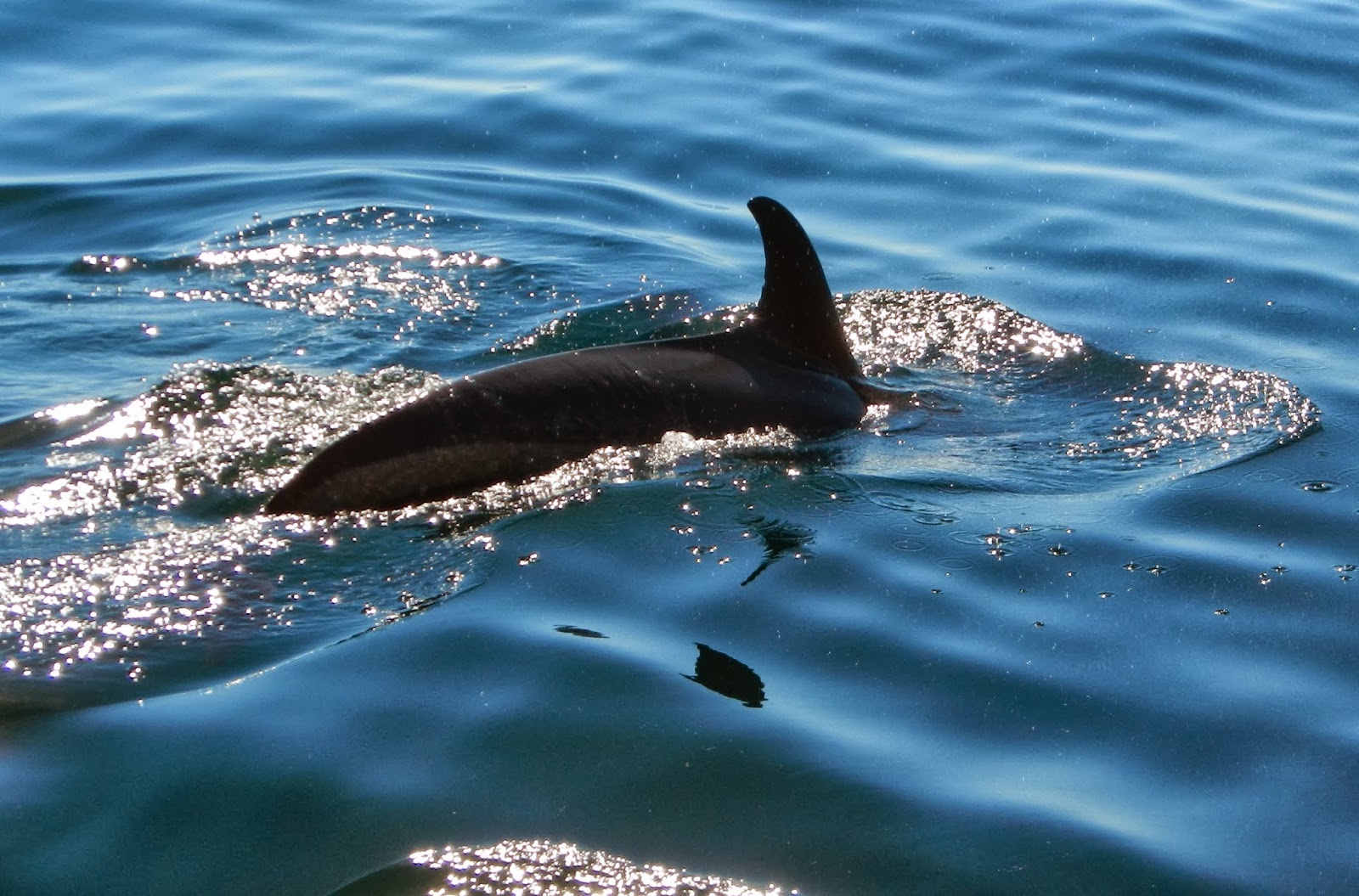
Porpoises popped up all around us, puffing as they went.
Mola mola were everywhere! These freaks are my absolute favs. Squee! Squee! (That's me squealing in delight!)
By ten o'clock we are halfway to Nova Scotia, way out in the middle of the Bay of Fundy. Although we are looking for basking sharks, we are delighted to instead find an unusual visitor to the Bay -- a sperm whale. A couple of these amazing animals -- the largest of the toothed whales -- have been reported in this area, and when we see a puffy, asymmetrical blow rise above a whale on the horizon, we know we have found one. Their single blowhole isn't found in the midline of their head, as is the rule for other groups of whales, but has migrated to the left side of their head. (Here's a great pic of this oddity.)
Sperm whales are rather extraordinary creatures. They are deep divers, sometimes reaching depths of over a mile, and can go without breathing for well over an hour. They typically forage on prey items at depth, with giant squid being the prey they are famous for pursuing, but they take many other animals, particularly fish. Finding food in the deep oceans is a challenge, as light doesn't penetrate very far into the water column. The sperm whale has therefore evolved a spectacular ability to echolocate, using sonar to sense the environment at depth and locate individual prey items.
We sit quietly near the whale, watching as it breathes repeatedly on the surface. Today, the research team has brought along a hydrophone -- a microphone that works underwater -- and we decide to toss it overboard to eavesdrop on the whale. Sperm whales are the loudest of all the animals on earth, broadcasting sounds at over 230 decibels. That's loud -- imagine a shotgun being fired by a neighbor standing next to you. If this whale is making any noise, we're likely to hear it. (Interested in sperm whale acoustics? Google "sperm whale monkey lips". Go ahead, do it.)
Notice the bushy, assymetrical blow, typical of a sperm whale.
A sperm whale sounding.
The whale dives just as we toss the hydrophone over, and the first
thing we hear is a series of clicks that sounds like a depth finder from
a boat. But it isn't; it's our sperm whale clicking away; either
echolocating or communicating with another whale. Soon this sound
grows, and we hear a series of Ka-pams, which sound much like a gunshot.
All of us on the boat are transfixed as we listen to the whale. The
clicking and "gunshots" go on for about five minutes, then the pace of
clicking changes dramatically, and we hear what is called "creaking" --
clicks coming so close together it sounds like a squeaky door closing
in a ghost story. This becomes quite frenzied, then suddenly stops.
"He's found something . . ." Andrew says quietly. "Aaaaaand . . . Chomp!"
We
speculate on what our sperm whale might be eating. Big cod? Some
other fish? Probably not a giant squid, that much is for sure. Whatever it was, we are all thrilled to have had the chance to hear this sperm whale's noisy hunt. Even for seasoned field biologists like Heather and Andrew, this was a special event to witness, a day we will remember for a long time.
Eventually Karina picks up her binoculars and starts to scan the horizon for basking sharks. She is a hard worker and will be a good biologist as her career progresses. Our brief distraction is over, and we pull the hydrophone out of the water and head on our way. We have a few more promising leads, but are unable to approach them before the shark dives below the surface. Soon the wind picks up. The tide turns, and in the Bay of Fundy this is a big deal. The strong currents of the outgoing tides are opposing the light wind, whipping up a chop on the water. Suddenly we are unable to find any more fins rising above the water, and we decide it's a waste of time and gas to continue. Andrew turns the boat towards home, where plenty more work must be done. After a quick ride back to North Head, we unload the boat, carry gear back to the field station, and clean it to prevent salt water residue from destroying it. Pictures are downloaded and categorized; samples are carefully loaded into freezers, and notes are transcribed onto computers. This is the part of marine biology no one thinks about, the glamour-free part, but is as essential as the field work.
After this work is done, we break out some beverages and talk over the highlights of the day. For me, it has been extraordinary. The massive sharks, the charming molas, the seabirds flitting around us, the sperm whale are all dancing around in my head. We talk about what we know about the animals we've seen, and what we don't know. The things we don't know are the most interesting part of our discussion -- science is, after all, about questions. There are plenty more questions to be asked about basking sharks. We stay up late hypothesizing and speculating. I try to put in a plug for starting to study molas, which Heather sees through in a heartbeat. But maybe I can convert them. I mean, basking sharks are cool, but molas -- over the top.
Whatever questions they ask about in the future, I hope I'll get to hear about Heather and Andrew's progress in answering them.
Nuf' said.
For more information about the Grand Manan Whale and Seabird Research Station (like how to donate a few clams to help them out), go to their website.
Last week, an old friend emailed an offer I couldn't refuse. A basking shark (Cetorhinus maximus) tagged
off Grand Manan in the Bay of Fundy, had gone on walkabout. The pop up
tag, designed to float free after a few days recording the shark's
behavior, was phoning home. Andrew Westgate, from UNCW and the Grand Manan Whale and Seabird Research Station, was on a quest to get it back. And I got to ride along. (Dory stayed at the doggy hotel, having her spots polished, as Damon likes to say. He was at Kent Island.)
Basking sharks, bizarre and extraordinary, are the second largest fish on the planet. And they grow to such great lengths -- 40 feet -- not through spectacular and gruesome acts of predation, but through filter feeding. The "basking" in basking shark comes from their habit of spending so much time on the surface (Andrew's tags indicate they can spend as much as 40% of their time there) and the leisurely pace of their swimming. In the Gulf of Maine, basking sharks concentrate there foraging on Copepoda, using modifications to their gills called rakers. (Want to see more? Check out this nice documentary.) In an apparent case of convergent evolution, basking sharks are remarkably similar to right whales. (Which gets me wondering what mechanism prevents them from competing for the same niche while they are in the Gulf of Maine.) Both are ponderously large, slow-moving, surface dwelling plankton eaters. It's no surprise, then, that basking sharks face many of the same threats as right whales: over exploitation, entanglement in surface fishing gear, and ship strikes. So learning more about their behavior is an important step towards conservation of the species.
Andrew's group started researching basking sharks in the Bay of Fundy in 2008; deploying tags that record behavior on a short time scale; other tags that record location over several months; and conducting aerial surveys in the Gulf of Maine. They also are assembling a photo-id catalog of dorsal fins, because it turns out you can track an individual over time through the unique fins (as you can bottlenose dolphins by they fins, or humpback whales by their flukes). The tag we were hunting for was floating some 40+ miles southeast of Mount Desert Island, sending its location up to satellites. Andrew chartered Osprey, the College of the Atlantic's outstanding new research and teaching vessel, to go after it. We lucked out with the weather -- a late September's day was never so fair as last Saturday: 70 degrees and northwest winds 0 - 5 knots. It wasn't quite a Beaufort 0, but it was close -- nearly flat calm. We left Bar Harbor under the shadow of two enormous cruise ships and headed out past the cliffs of Acadia. Lobster bouys peppered the water until we reached Mt Desert Rock, where they slowly petered out. Cadillac Mountain, a looming monster on land, grew smaller and smaller, then was no more. Herring gulls grew less common and pelagic birds flew by to check us out.
College of the Atlantic's amazing research and education vessel.
Osprey's crew.
Andrew and Captain Toby Stephenson discuss the plan of action.
It might seem like finding a tag the size of a cucumber would be the proverbial needle in the haystack, but we found the tag with no problem. A couple of miles from where we expected to find the tag, Andrew donned his headphones and tracking gear to pick up the radio signals the tag was emitting. He was able to pick up a good signal and point the boat towards the tag, which we simply scooped up with a net. (The tag was entrained in a raft of seaweed, just as Andrew said it would be.) I'm sure it was a moment of relief for Andrew when we brought it aboard. He never expected a shark would carry it so far offshore or so far from home.
Andrew listening for radio signals with a "yagi" antenna.
Quarry captured. Phew.
Explaining how the tag works.
I'd call, wouldn't you?
Beyond the tag, it was a spectacular day for wildlife. Humpback whales, white-sided dolphins, pilot whales, two -- yes two -- encounters with Mola molas, and a blue shark. I rarely get to head so far offshore, and never on such a nice day. With the seas so calm, we could see disturbance on the water far in the distance -- a hint that wildlife was probably there. One of the pleasures of the day was spending time with a crew who was as fascinated by the animals we encountered as we were. Any little hint of a whale sent us off to investigate. Osprey was a sweet ride with a terrific crew.
Taking photos of humpback flukes for photo id.
Looking the fluke catalog to determine who it was.
Pilot whales.
Atlantic white-sided dolphins.
Mola mola! MOLA MOLA!
One of our humpbacks.
Alas, it had to end. We steamed into Bar Harbor (past an enormous cruise ship on its way out) just as the sun was falling behind Cadillac Mountain. It was a satisfying day all around -- tag recovery, amazing wildlife, and a visit with an old friend. Any other old friends want to let me "tag along" -- just call me. I'll drop my grading and be right there.