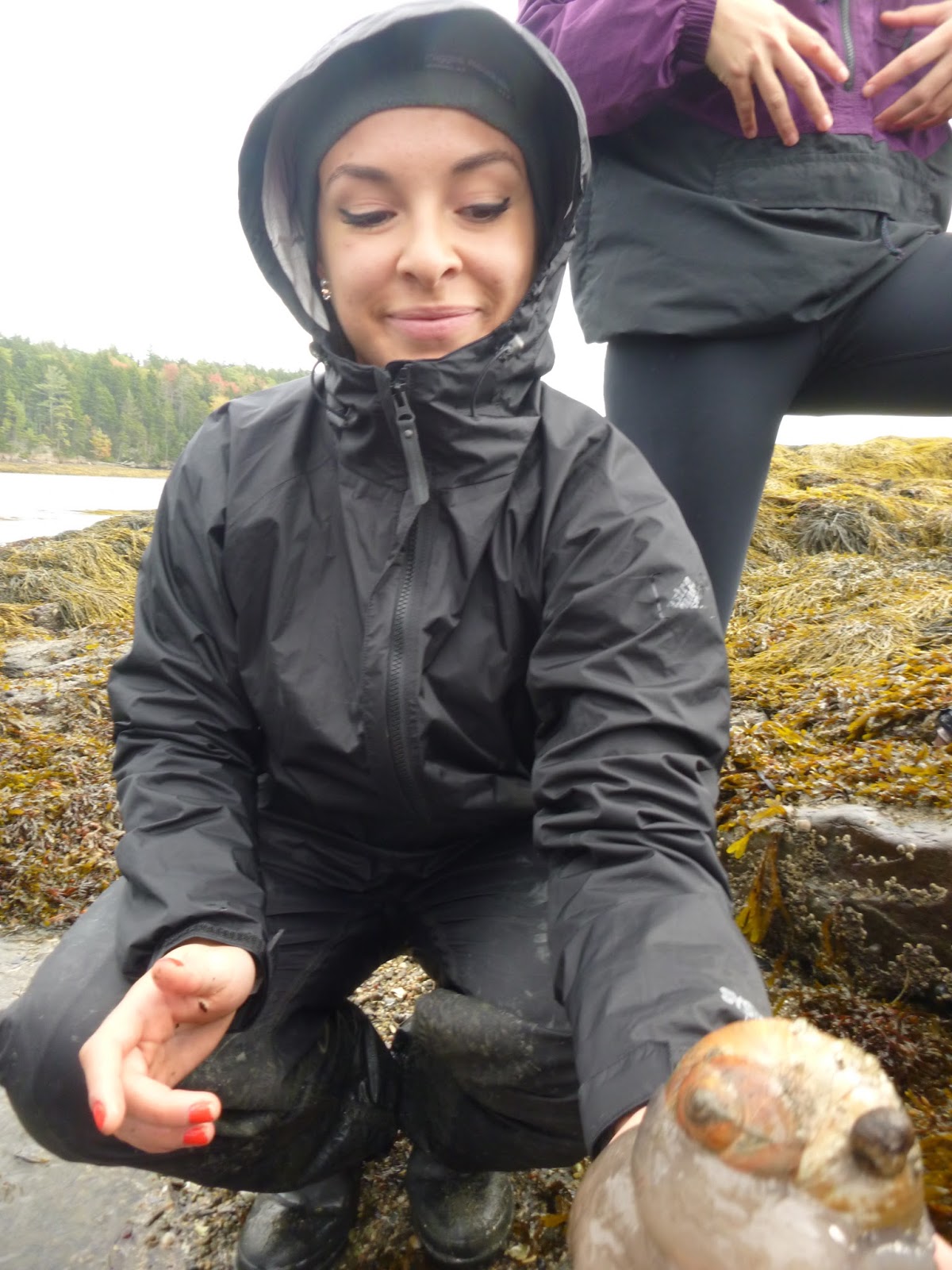
No lab is anticipated more than the mudflats lab I lead each fall. For some, the anticipation is tinged with dread, as they envision themselves dirty and cold and wet, pulling up unrecognizable worms. For others, it's all an adventure to be enjoyed. For me, it's the best lab of the season -- one where we always encounter new habitats and organisms. This is when my appreciation of a student increases exponentially when I see her kneeling in the mud, quietly picking through the algae looking for organisms. When we are children again, turning over rocks and digging up thick muck. Squealing with delight over our finds. And yes, getting dirty. For some people, really dirty. You can't explore a mudflat without falling over once in a while.
I give two excellent prizes for this lab: One for the muddiest person, one for the person who finds the coolest thing. This year we had two candidates for muddiest person, but making the choice for coolest find will be tough -- in that we found more moon snails than we've ever found, and many other amazing things -- rock gunnels, tiny sipunculids (peanut worms!), nemertians (ferocious wrom predators), crabs the color of shells, etc. etc. It'll be a tough decision . . . .
I could go with the obvious choice, moon snails. They are my favorite. But there were so many of them -- exponentially more than any other trip -- that is seems difficult to say they are particularly rare this year. How many did we find? This many:
I love hearing a student say "What's this? OH MY GOSH IT'S HUGE!"
Steve Dudgeon came along and shared his considerable knowledge.
Passing one around to amaze ourselves.
This is an odd place to find two -- count 'em two -- moon snails. Rocks? Odd.
Brave student!
Look at that foot!
A little one!
Our cup runneth over.
She's thinking "What the . . . ?"
This is more commonly where I find them!
Sarah Kingston found this hard-shell clam with a drill hole from a moon snail!
Well, after all those moon snails, everything else might just be icing on the cake. But really, all this stuff is amazing in and of itself. Take a look:
Green crabs in the most beautiful shell hash colors. What camouflage!
Loads of Mercenaria! Quahogs or hard shell clams.
I do love a rock gunnel!
Two is even better!
Whoa! Lady Asian shorecrab.
Peanut worms. A big one and a baby. Don't you dare say "ew".
Annie's not freaked out. Why should you be?
All this bounty wasn't easily won. We got a little stuck in the mud. That's half the fun.
Boot stuck? Pull it out with your hands!
Oh, I hate it when they fall. I know what it's like.
This is why the mudflats are poorly studied.
Using a bucket for help. Smart.
Oh, this is a serious case of mud. Annie's in the running for a prize!
I have to thank my wonderful students letting me drag them along on my adventures. They think I'm doing it for them! Ha. Seriously, they pay me for this?
Soft-shell clams are important in Maine -- both ecologically and economically. So it's not surprising to see them in the news once in a while. But recently I feel like I've seen a lot about them, here, and here, and here, to name a few. So I thought I'd take some time to wade through these issues and explore their causes and what they might mean.
Bags of clams on the Freeport Town Docks.
Ocean Acidification: Most of us are familiar with the threat of climate change, resulting from increased carbon dioxide in the atmosphere. One consequence of high atmospheric CO2 levels that many people are unaware of is ocean acidification, but it's a relatively straightforward concept. If you ever combined baking soda and vinegar, and were able to explain the resulting explosion of gas, you can understand ocean acidification. 1) Atmospheric carbon dioxide concentration is increasing. There is excellent evidence that atmospheric carbon dioxide levels are increasing consistently. In 1960, there were 315 ppm of CO2 in the atmosphere; where as today the level is 396.81 ppm. (The level considered safe and sustainable in terms of sustaining human culture and health is 350. Yeah, that's a downer. I would add that the vast majorityof scientists, as in, virtually all, support the idea that our modern society is causing this increase in carbon dioxide.)
2) Our oceans absorb about a third of the carbon in the atmosphere. CO2 can exist as a gas in the atmosphere, but it also can dissolve into water, and is absorbed by our rivers, lakes and oceans. The oceans have been an important buffer for the CO2 we've been pumping into the atmosphere, acting as a "sink". 3) Absorption of CO2 causes the oceans to become more acidic. A few reactions go into this process, but the end result is a bunch of CO3 2- (carbonate) and H+ (positively charged hydrogen ions). It's the conversion of the hydrogen in water to hydrogen ions that changes pH -- pH is a measure of how many of these H+ ions are around (a lower pH means a substance is more acidic and has more H+ ions). Since before the industrial revolution, the oceans have dropped from a pH of about 8.2 to their present level of 8.1. This might seem like a small difference, but the pH scale is logrhythmic, so this actually is a large change, in fact representing an increase in H+ ions of at least 25%. 4) The end result of higher CO2 levels is a reduction in CO3 available for clams to make their shells. Shellfish (and corals, urchins, and plankton, to name a few) have shells composed largely of CaCO3 -- calcium carbonate. But they can only make these shells if the water is saturated with CO3. With all the extra H+ ions around, CO3 (which is negatively charged) is hard to come by for clams. Plus, their shells can dissolve in acidic water -- just like when you combine vinegar and baking soda (which is full of carbonate). This is leading to thinner shells for many species (but some species actually do better with greater CO2 levels -- like lobster).
On their way to the dinner table.
It's been a very busy week for me here at school -- a new semester is well underway, and this year my work load has doubled (no, my salary has not, unfortunately). I think I'll save the green crab portion of this problem for next week! Those papers aren't going to grade themselves, now, are they?