Wednesday, August 6, 2014

Week Downeast, Day 2

The weather was perfect to go whale watching in Passamaquoddy Bay today, and we don't let perfect days go unused here in Maine.  So it was out on the Ada C. Lore for us, with some sun screen, our binocs, and a camera.  
A little distraction before getting on the boat -- incredible sea urchins and sea stars on the breakwater.  Well worth taking a look at!  (We also saw what I think were salps, but couldn't get a photo.)  It's always distressing to see how many people walk right by treasures like this, in their hurry to get the best seat on a whale watch boat.  Rant over.
Ada C Lore is a big ol' girl!
And pretty.  One of the cool things about this whale watch was just enjoying the boat; an old oyster dredging boat from the Chesapeake.  Her restoration is really impressive and must have been a labor of love.
There wasn't much wind, and it's awfully hard to maneuver around whales under sail anyways; so they just raised one sail -- for looks.
And it looked great!
We "sailed" out along the western shore of Campobello Island in Head Harbor Passage, until we reached Head Harbor Light (AKA East Quoddy Head).  After a very quick foray into the Bay of Fundy, where the temperature dropped a good ten degrees and the wind picked right up.  It was a valuable lesson in oceanography! 
Passamaquoddy Bay is extraordinary for many reasons.  The cold, productive water is forced through narrow passages, resulting in a hefty biomass of baitfish (herring, to be exact).  Big predators, like this minke whale, cruise along between the islands, munching down fish by the ton.  This guy was working only a frontal boundary, where prey are often concentrated.
Whale footprints!  These are formed by the upstroke of the whale's flukes.  You can tell where a whale is if you can see these.
Harbor porpoises, like this mom and calf, were EVERYWHERE.  At one point there were a good dozen of these little guys (less than 100 pounds) charging around, driving fish up to the surface; where birds were picking them off in a noisy orgy of feeding.  Then a minke whale came into the picture, lunge feeding in a National Geographic quality display of agility.

This photo is for Shana, who says Damon needs to take more photos of me.
An absolute highlight of the trip wasn't an animal, or even a plant -- it was the Old Sow (who some would say is a living and breathing thing). The Old Sow is the second largest whirlpool in the world, and the largest in this hemisphere.  As water pours into Passamaquoddy Bay (where tides exceed twenty feet), they hit an underwater ledge here, forcing water up and over the ledge in a confused, tumbling mess.  If you love the ocean, this is one place you must go to.  We could see the water "humping" up when we were over the ledge, and running "downhill" on either side.  Dozens of angry whirlpools formed around us, as we moved backwards and sideways despite the fact that the engines were pushing us forwards.  Even her "piglets" were impressive.  This is something amusement parks might try to replicate, but their efforts would be wasted.  It was an amazing finale to an excellent day on the water.

Monday, August 4, 2014

Week Downeast, Day 1

8 AM:  We run downtown to grab a quick breakfast at the Bakery in Eastport.  Things are quiet on a Monday morning, but promise to pick up.  We eat at the waterfront amphitheater, where there will be an evening concert on Wednesday, and stroll along the waterfront before taking off for the day.


10 AM:  As fog rolls in from the Bay of Fundy, we head out onto the flats at Cutler.  Clammers drive right out onto the flats here and dig as the tides roll out then in.  We make our way out to a rock island, covered in Ascophyllum nodosum, and search for green crabs.  There are plenty under the rocks, but none on the flats. The dog has a fine time roaming around off leash, and we tell the clammers we're just tourists in Dunlops (our green rubber boots, a favorite amongst the fishing crowd).


12 PM:  We hike out the Coastal Trail at Cutler Public Lands Reserve, hoping to get a glimpse of Grand Manan Island from the States.  We know we're getting close to the ocean when the temperature drops a good ten degrees.  No surprise though -- the fog is thick in Grand Manan Channel, so there'll be no view of Grand Manan for us.  I head back to the trailhead while Damon goes for a run along the extensive trails. Whlie I wait for him, I pick ripe raspberries, and even save some for tomorrow's breakfast.


3 PM:  The dog tolerates yet another hike at West Quoddy Head, the easternmost point in the United States.  Competing foghorns come from every direction on the Coast Guard Trail.  Luckily it's an easy trail with a terrific overlook at the end.


5 PM:  We stop into Lubec for a snack on the deck of the Water Street Tavern and Inn, watching the tide rip along between Lubec and Campobello.  Seals pop up in the narrows and the ferry from Eastport pulls in with a full cargo of tourists.


7 PM:  Drinks on the deck as the sun goes down, followed by a dinner of grilled portobello mushrooms, corn on the cob, and a big salad.  The dog collapses after a long day, and Damon and I plan our big day tomorrow -- whale watching in Passamaquoddy Bay.


Saturday, August 2, 2014

The Best Sandy Beach in Maine?

Okay, it's time to let you in on a little secret.  As long as you promise not to tell anyone, I'll fill you in on the best beach in Maine.  A beach where you don't have to fight crowds to enjoy natural scenery unspoiled by condos and campgrounds and ice cream stands and kitsch.

Morse Mountain.

There, I've said it.  Normally, I'd jealously guard a secret like this, lest I spoil it.  Inviting all you hordes of people (all of the two or so people who read this blog!) might just ruin a good thing.  But in this case, I think I'm safe, because Morse Mountain has a way of weeding out the crowds, thinning them to just the right amount:  parking is quite limited, there are no facilities, all that beach paraphernalia most of us love -- kites and boogie boards and boom boxes -- are prohibited, and oh yeah -- you're gonna have to walk two miles in to the beach.  Over Morse Mountain.  And two miles back!   That sort of thing tends to limit the numbers pretty effectively.

Recently some lady friends and I headed out on an expedition to Morse Mountain.  It was a picture perfect summer morning in Maine -- not too hot, not too cold, sun shining down on us.  We met in the very small parking lot, where the attendant asked us to back in and park as close as possible, so more cars could fit. I'm going to admit I put on a ton of poisonous bug spray, since I'd been there before and knew the mosquitoes were Maine's Most Enthusiastic.  We filled our bags with snacks and water, and went on our way.  (BTW, the dog stayed home -- dogs are persona non grata at Morse Mountain.  I repeat:  Leave. Your. Dog. At. Home.)  And since a picture paints a thousand words, I'll just stop typing now:

Hiking to the beach.  It's not difficult, but for that "mountain" you have to go over.  The actual young ladies, not those just young at heart, led the way.
Let's all remember this moment, so in February we can think back on how verdant and warm we were.
This is your reward for humping up Morse Mountain -- spectacular view of the marsh below, and Cape Small in the background.  Osprey fly below you here.  
Once you get to the beach, this is what you see when you look west . . . 
. . . and this is what you see when you look east.  As you can see, the crowds are terrible.
Some people swam for a bit . . . .
. . . while others looked on in admiration.  Or horror.  That water is cold!
Then we got down to business:  looking for cool stuff.  We found this quahog that'd been preyed upon by a snail -- either a moon snail or waved whelk.  What a perfect hole they leave in their poor dinner.
Anja found this perfectly good, but wet, hat.  A run through the dishwasher will make this brand new.
Julie rescued this sign from the tumbling surf.  Plovers nest on the beach, and need special protection from idiotic humans like us.  Julie pulled this from the ocean, found a rock and replanted this in an appropriate location -- she did her good deed for the day!
This fencing protects a plover nest -- from predators, and humans who might like to play frisbee in that particular spot.
We found this too -- a set of deer tracks.  Humans aren't the only beachgoers out there@
Eventually we just started monkeying around.
And became bathing beauties!
All good things must end.  Our shoes went back on; our backpacks were lighter since we were carrying most of our provisions in our bellies; and we were all thinking about lunch at Sebasco Harbor.
GETTING THERE:  I highly recommend Morse Mountain -- only for people who can walk long distances. And people with a conservation ethic.  The area is protected by several entities, including Bates College and the Small Point Association.  These folks ask visitors to follow several rules, and in exchange share this amazing treasure with us.  If you think you make the cut, here's how to get there:  From US1 in Bath, take Rt 209 south and follow it 11 1/4 miles.  At that point, Rt 209 turns left (towards Popham Beach State Park); you should go straight on Rt 214.  Go ~ 3/4 miles; Morse Mountain will be on your left.  Have fun, go to the bathroom before you go (no facilities, whatsoever), bring bug spray, and bring your water and snacks.

Tuesday, July 29, 2014

Reasons to Love Knotted Wrack (Ascophyllum nodosum)


Ascophyllum nodosum, AKA rockweed, AKA knotted wrack.  It might seem like a lowly organism, merely a bit player in the drama of Maine's coast.  I mean, aren't seastars and lobsters and anemones so much more glamorous?  But Ascophyllum is one of the stars of the Maine coast, exerting a fundamental influence on the intertidal community around it.  So here, without further ado, are ten reasons we all should love knotted wrack:


1.  Knotted wrack lives a really, really long time.

It's not unusual for knotted wrack fronds to be fifteen or more years old, and for their holdfasts to live for decades, or maybe even centuries.  (A holdfast is where marine algae attaches to the substrate.  Seaweed doesn't have roots; rather, their tough holdfasts grab onto rocks, mussels, or other solid objects.)  When a frond breaks, it regenerates from the holdfast.  Next time you look at a holdfast, realize it might be older than you.  Or your parents.  Or your grandparents!


2.  You can tell how old a knotted wrack frond is just by counting the air bladders.

Knotted wrack lays down one air bladder each growing season.  That makes figuring out how old a frond is easy.


3.  Individual knotted wrack fronds can grow meters long -- but very, very slowly.

See?  (Note, fronds are much smaller at sites with more wave exposure than at wave-protected sites.  This was taken at a site where waves only occur in the worst of storms.)  It's amazing to think knotted wrack grows only about 10 cm a year (two and a half inches) and makes it to these great lengths.


4.  Knotted wrack creates a cooling canopy over the rocky intertidal at low tide.

The intertidal portion of the coast is a very stressful place for ocean organisms.  All of the algae and animals we find in the intertidal are derived from ancestors in the sea.  Emerging out of the sea places great physiological stress on them -- especially thermal stress and desiccation.  Amazingly, the rocky intertidal habitat is a very hot place in summer -- too hot for comfort if you're an intertidal organism.  But Ascophyllum provides cooling shade and a moist canopy, protecting the species under it from overheating. In summer, temperatures under an algal canopy of knotted wrack can be 5-10 degrees (F) lower than without it. (It's also warmer in winter, preventing organisms from freezing.)  This is particularly important in the high intertidal.


5.  Knotted wrack reduces wave impacts on organisms living under the canopy.

The energy required to hold on when a wave hits the beach can be substantial.  Knotted wrack can act as a wave buffer, allowing organisms to put more energy into other activities -- like growing and having babies.


6.  Knotted wrack is an ecosystem engineer that fundamentally influences the community of organisms around it.

Knotted wrack has such a large influence on the community around it that it can be thought of as an ecosystem engineer or foundation species, just like coral reefs or sea otters are.  The habitat around knotted wrack changes fundamentally simply because it is there.  Without knotted wrack, it's a place where the sun bakes the substrate at low tide, the waves wash away organisms at high tide, and space for growing is limited.  With knotted wrack, it's a cool(er), wave-buffered, complex habitat with lots of things to hold onto and grow.  Knotted wrack's long fronds -- that persist for decades -- influence their surroundings greatly. Everything from sponges, crabs, nudibranchs and snails to barnacles, smaller seaweeds adapted to low-light conditions, mussels and limpets find a comfy home under the knotted wrack layer.  Knotted wrack also provides substrate for other organisms to grow on -- other seaweeds, worms and snails all live on the seaweed itself.  Predators like gulls have a harder time finding tasty morsels like crabs when they're hidden in knotted wrack too.  However, knotted wrack isn't all good -- it can easily sweep other organisms away (especially babies just settled out of the plankton).


7.  Knotted wrack spores are wimpy.

Despite the dominance of giant knotted wrack stands all over Maine's coast, their spores (like seeds) aren't very robust. Knotted wrack reproduces by making spores that move with the currents and eventually settle on the best hard substrate they can find.  If this substrate happens to be exposed to waves -- even small ones -- the spores simply can't hold on.  That's why it's common to see vast stretches of protected bays blanketed in knotted wrack, but uncommon to see it on exposed headlands.


8.  Littorina obtusata -- a beautiful little snail -- lives in knotted wrack.

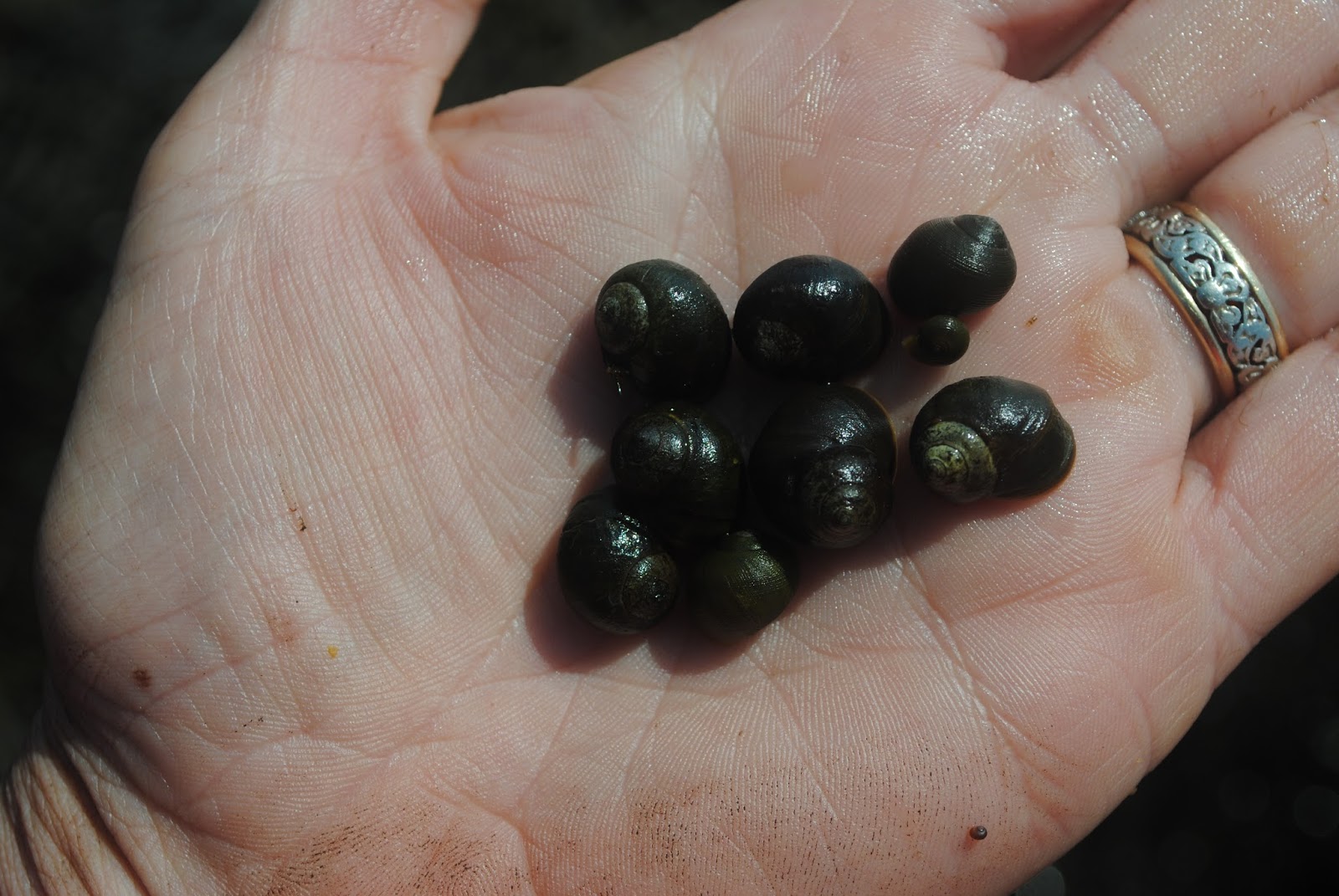
Smooth perwinkles -- Litterina obtusata -- lives exclusively on knotted wrack fronds.  They eat both the knotted wrack itself, and epiphytes that grow on knotted wrack.  Rumor has it they even lay their eggs in the air bladders, but I've never seen it myself.


9.  Eiders forage in knotted wrack, and their babies hide in it.

I've got a soft spot for common eiders.  Kent Island, where I spend my summers, was bought by Sterling Rockefeller in 1930 to save the last known nesting eider population in the Gulf of Maine.  There were less than 30 nesting pairs in the entire Gulf of Maine at the time, almost all of them breeding on Kent Island. Rockefeller sold Kent Island to Bowdoin College for a dollar not long afterwards, with the stipulation it would be used as a wildlife sanctuary and research facility.  You can read about this interesting story here.

Eiders are sea ducks that live in large aggregations during the breeding season, nesting on islands.  During this time they forage in knotted wrack for small invertebrates, like snails (see #8) or mussels.  Baby eiders head out into the ocean very early in their life -- 12 to 48 hours after hatching, and are highly vulnerable to predation by gulls and eagles.  Hiding is an important strategy to survive another day, and baby eiders are pretty good at it, hunkering down in the knotted wrack fronds along the shoreline.


10.  Knotted wrack forms a structurally complex underwater forest at high tide.

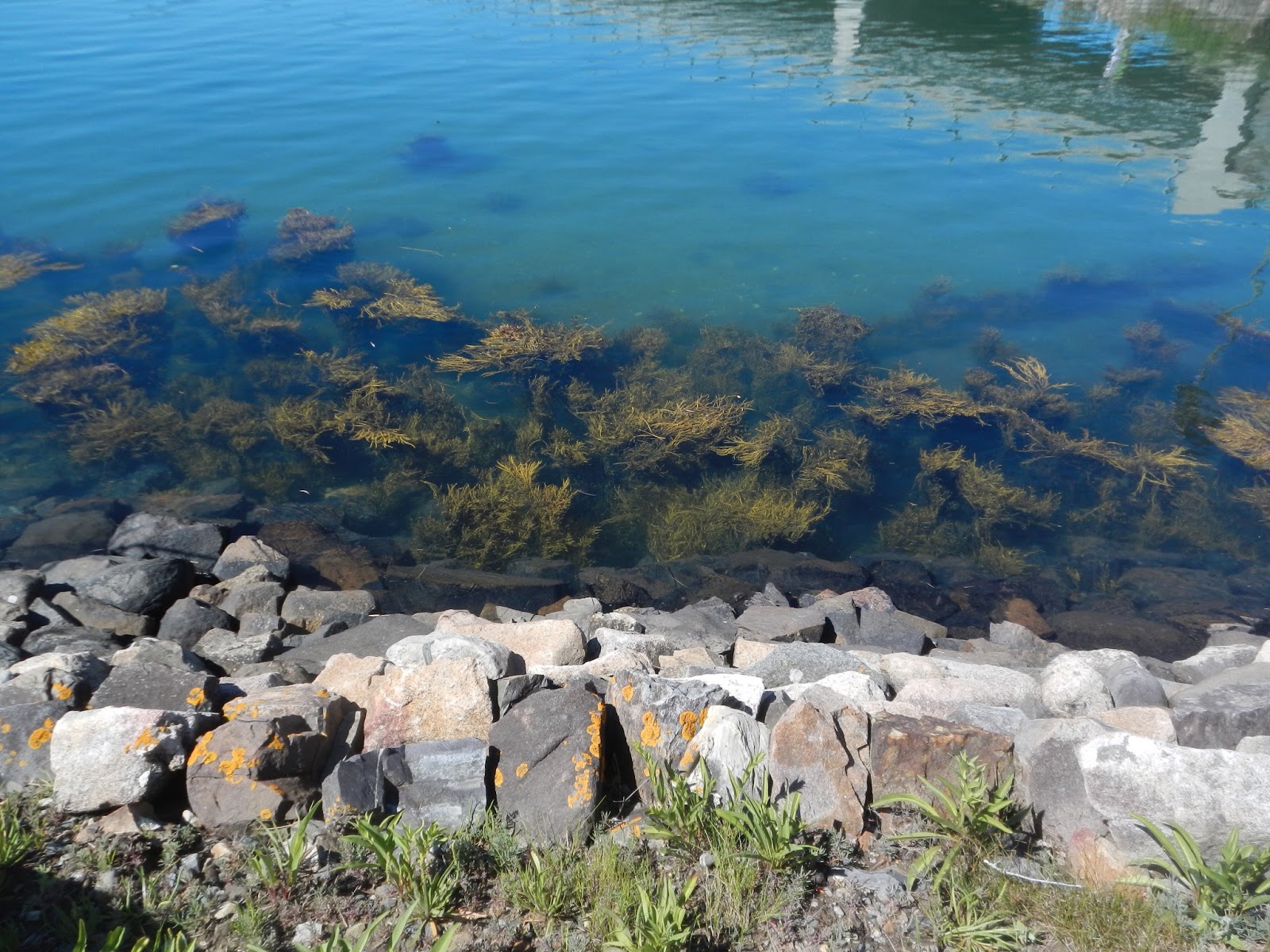
It might seem, to terrestrial observers like you and I, that knotted wrack just lays there on the bottom.  But we should remember that what we see of the intertidal is only half the story -- the low tide half.  When the tide is in, knotted wrack is bouyed into a thicket of fronds, nothing like what we expect.


Interested in knotted wrack (who wouldn't be)?  You can find it in almost any coastal site that's protected from waves.  Some good places to investigate it are Bowdoin College's Coastal Studies Center in Harpswell, Ocean Point in East Boothbay, or Wolfe's Neck State Park.  Wear shoes that can get wet and use caution; walking on knotted wrack can be tricky.  But get out there, look under those fronds, and have fun.  Just do it at low tide.