Thursday, July 24, 2014

Two Lights, and Two Lights


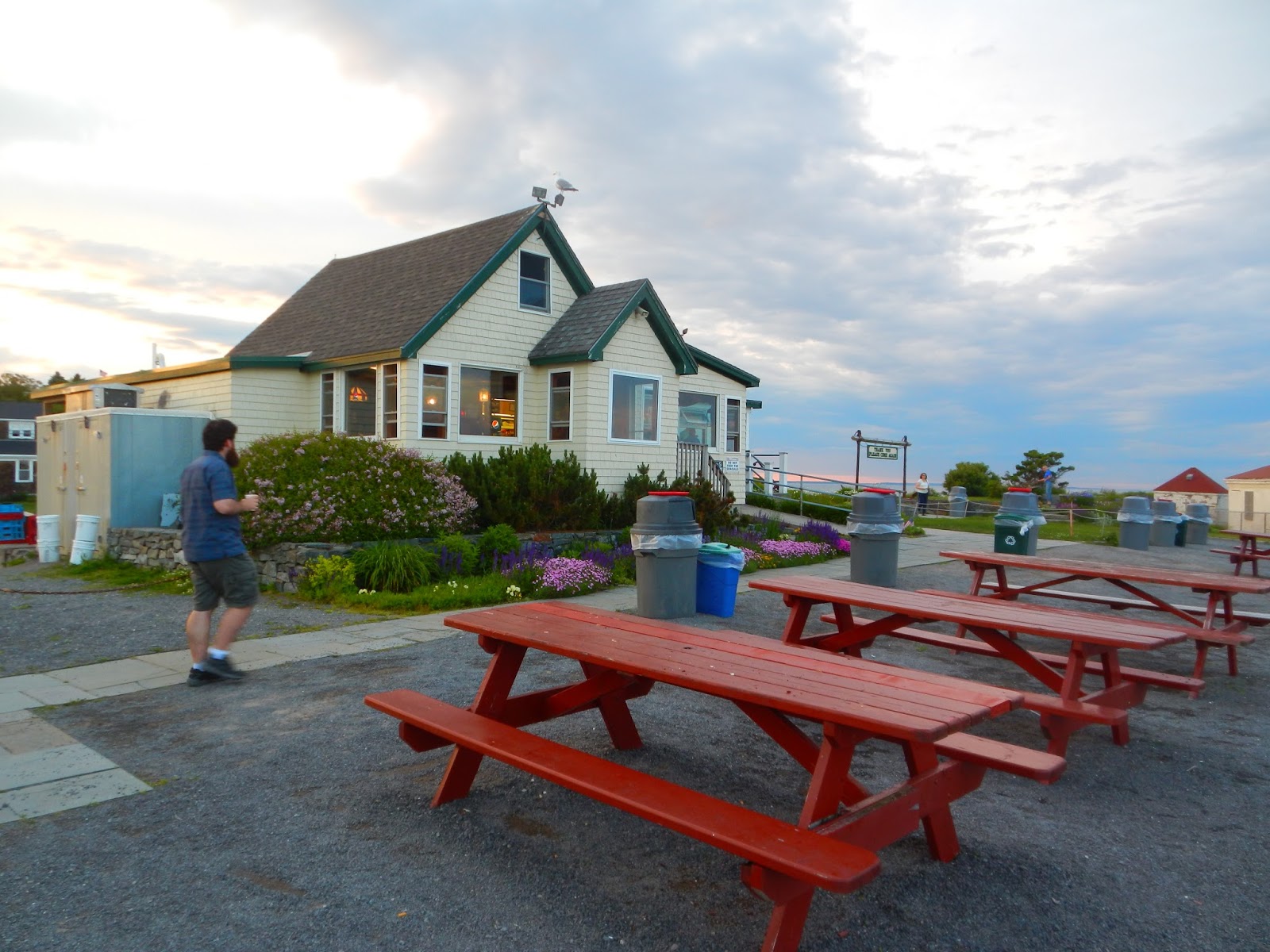
One of the two lights, as photographed from the Lobster Shack.

While I was home from the island I threw the dog in the car and headed down to Cape Elizabeth for a quick evening outing.  A couple of years ago Damon and I crewed on a offshore sailboat race, a great way to recover from our summer on the island.  We had spectacular weather, and beat down along the Cape Elizabeth coast as night fell.  As we ground winches and trim sails, we tacked just offshore of Two Lights -- both the state park and the lobster shack.  In the evening light they both looked so beautiful.  Now I finally managed to make it back, with a view from land to sea this time!

Two Lights State Park seems to really confuse people, if you read Tripadvisor on a regular basis.  Everyone expects there will be two lighthouses in the park, but nary a lighthouse will be found there.  Rather, you'll find some amazing picnic spots, crashing waves on a rocky outcropping, some lovely upland trail, and old artillery ruins from WWII.  This is the place to be for sunsets, even sans lighthouses.

Crashing surf on the rocks, and someone contemplating the enormity of the ocean.  Or napping, I can't really tell.

A word to the wise:  rocks by the ocean are slippery, and waves are dangerous.  Take heed.

The beast in her natural habitat.


If a lighthouse is what you want to see, get thee to the Lobster Shack, right down the road.  You'll have a great view of one of the two lights, plus enjoy some great seafood in what must be the most spectacular setting in Maine (and that's saying a lot).  The evening I was there, a wedding party was rehearsing on the lawn, tourists from all over were enjoying dinners, and gulls were trying their best to snatch a bite or two from an unsuspecting diner.  I of course had to try a lobster roll; my usual in this situation.  It was fine -- but I have to admit, I was pretty turned off by the big, glistening dollop of mayo they put on it.  Luckily, that was easy to scrape off, so I could enjoy my lobster roll in paradise.


See what I'm saying?


Monday, July 21, 2014

Peaks to Portland

Last week I headed down to Portland to watch the finish of the Peaks to Portland swim.  I am in awe of people who swim in open water.  Many years ago, I completed a sprint triathlon, and learned that training in a pool is oh so different from swimming in the ocean.  Every 2 inch wavelet seemed like it was trying to drown me.  It wasn't a pretty sight.

So my respect for folks who swim competitively in the ocean is great.  The Peaks to Portland, a fundraiser for the Portland YMCA, is 2.4 miles long, from Peaks Island to East End Beach in Portland.  The water was in the high 50's/low 60's; making for a cold swim, even in a wet suit.  It was a great morning; worth an early morning drive to the big city.

Before the race started, an army of volunteers prepped the finish line.  There were water bottles to put out . . .

. . . and oranges to cut up . . . 

. . . and medals to prepare.

Then we waited . . . 

. . . and played with the dogs (it's a dog-friendly beach in the early morning) . . . 

. . . and scanned the horizon for signs of swimmers.

Then far, far on the horizon, we could see tiny specks that grew bigger and bigger.

Until finally the lead swimmer charged through the moored boats and into the finishing chute!

And the leaders' escort kayaks made their way to the boat ramp.

Eventually a huge pack of swimmers and kayaks streamed our way.
The kayaks poured up the boat ramp (I helped carry for awhile).

This must be a dream come true for LL Bean and other outfitters.  This is only a small fraction of the kayaks.

Congrats to the finishers!  Great job.

Friday, July 11, 2014

Guest Bloggers -- Hannah and Josie Go Whalewatching

A humpback whale sounds near the boat.
It's been a busy week for me -- home from the island for some work and pleasure -- so I thought I might trick someone into writing a blog post for me provide an educational opportunity for some young scientists. Yesterday my young friends Hannah and Josie joined me for a whale watch, and here's what they have to say:

Before the whale watch we ate lunch at the Cape Ann Brewing Pub.

As you can see, we didn't like it very much.
Josie:  Today we went on a whale watch.  I loved it so much.  We saw humpback, minke, and fin whales. My favorite of them all was the humpback.  We saw them fluke, breach, and make bubble traps.

When they fluke, they come up to the surface of the water and whip their tails up in the air.

When they breach, they jump up out of the water and their full body comes out of the water and slaps back down on (and into) the water.

When they make bubble traps, one to seven whales blow bubbles out of their blow holes and make bubbles in a circle around prey which are mostly sandlance, which are a type of fish.  The bubbles confuse and trap the sandlance.  Then the whales swim up from below with an open mouth and eat the fish.


Hannah:  The whale jumped.  In what seemed slow motion, the head, speckled with barnacles, rose out of the water.  Following close behind, its great big front flippers whipped wildly next to it, causing ocean water to spray behind.  The heavy tail lifted and the whale leaned back in a big arc.  It plunged into the depths of the deep blue waves, splashing everything in about a seven foot radius.  The very last tip of the tail disappeared.    Ripples filled the water, the last mark of a whale I'd never see again.

We got a great view of all the action.   The whales were EVERYWHERE!

This whale is showing us his fluke pattern.  Every whale has a different pattern, so it's like a fingerprint.

A bubble net, with whales about to surface in the middle.

Whales feeding in the middle of a bubble net.  The birds are all hoping to get some too!

This whale has a full mouth!
Some notes from the Ocean Lover:  Hannah, Josie and I went whale watching out of Gloucester, Mass, on the Seven Seas Whale Watch.  Whale sightings have been excellent in the past few weeks, and we saw a ton of whales -- the first one just outside of the Gloucester Breakwater.  A very large group of feeding humpbacks (~20) crowded on Tilley's Bank, allowing us to observe bubble net feeding, tail slap feeding, and a single breach just feet from the boat.  Our naturalist was kind enough to spend some time with my young friends, and told us she was able to quickly identify three of the whales we'd been watching; Wyoming (sex unknown), first seen in 1988; Cove (male), first seen in 1982; and Lynx (female with seven known calves to her name), first seen in 1981.  

Not all whale watches are created equal.  If you're interested in whale watching, I recommend going with a company that either partners with a conservation or research organization (Seven Seas partners with Ocean Alliance), or one that is a member of Whale Sense (a program that promotes responsible whale watching). Whale watching can be disruptive to whales if not done carefully,and a recent study by the International Whaling Commission showed whale watch boats represent the greatest threat to whales in terms of ship strikes.  Supporting companies that treat whales respectfully is one way you can do your part for the oceans.


Thursday, July 10, 2014

The Egg Hunt -- Black Guillemots

Time is passing quickly on the island, and everyone is rushing to complete their research before we all head home.  Luckily, people are all willing to pitch in and help with collect data, especially if it involves a trip to the next island over and a hunt for black guillemot nests.

Black guillemots on Kent Island.
Guillemots (Cepphus grylle) are rather charming little seabirds, not too distantly related to puffins.  These little guys are black and white, with rather striking red feet and mouths (inside their beaks).  They forage along the shoreline, diving for up to two minutes at a time as they use their wings to push them through the water to hunt small fish and invertebrates.  Guillemots lay their eggs ashore, usually under boulders, but sometimes in piles of driftwood or simply in a crevice along the shore.  One of our students is studying the nesting behavior of these cute little birds, and last week a bunch of us went on an expedition to Sheep Island to search for eggs one afternoon.

Before we got started looking, Damon and I got a bit distracted.  A humpback whale washed up on the island last October, and I hadn't gotten a chance to see it yet.  This is a known humpback (they are identifiable from the markings on their tails, which are photographed and cataloged), who was called "Harmonic".  In the cool northern climate, it takes quite a while for a whale to decompose, so here he was more than half a year later, still looking quite intact, although some baleen had been washed further along shore.


Harmonic, decomposing on shore.  He's on his back with his ventral pleats visible in this photo.
A large section of baleen washed up in the bushes. The inside of the baleen, a rough hair-like tangle of keratin, can be seen here.  This is used to capture fish inside the mouth. 

Once we had a good look at the whale, we joined the students and got down to business.  Sheep Island's west side is boulder-strewn, so this was quite an Easter-egg hunt:

Ideal nesting habitat for black guillemots; loads of boulders to hide eggs under.

Any eggs under here?

What about here?

Success!  Two eggs sitting on the ground under this rock.

Collecting data after finding eggs.
Once we got into it, we found a bunch of nests -- too many to process in the time we had ashore.  The curse of success!
This egg was just sitting out in the open.  This is not a very good strategy -- crows and gulls love to eat eggs!

These two eggs (look carefully) were well hidden in a pile of rocks.

This little gal was sitting on her eggs, watching us with suspicion.

Another egg sitting out in the open.  Competition for nest sites must be keen, if some birds resort to this.

Close up of an egg that was preyed on.  The colors are amazing!

Hang on a second -- that's not a guillemot!  (We had to use caution to not step on hidden gull chicks.)

Damon getting the skiff, to take us back to Kent (and a hearty dinner!)


Tuesday, July 8, 2014

Babies Babies Everywhere

Sometimes in America, when we are embroiled in modern life, shrunk wrapped into our cars and entombed in our suburban houses and vacuum-sealed into air-conditioned offices, it's hard to tell that summer's about more than barbecues, fireworks, and a trip to the beach.  For the vast majority of species out there, summer's about babies -- putting forth heroic efforts during a very short window of time to pass on DNA to the next generation.  But here on Kent Island, it's in our face, all the time.

My favorite nest site on the island; in a fish tote that washed up above the beach.  Looks super cozy.
Mama came right back to sit on her eggs once we moved on.
The herring gull eggs are hatching.  We have thousands of nests on the island, most with three eggs in them. That means thousands of fluffy little chicks, thousands of begging mouths to fill, and thousands of angry moms and dads when we get too close to a nest or hatchling.

Gulls can get downright dangerous if you venture too close to their nests. They mob us, swoop down on us, rake us on the head, scream in your ear, and poop with surprising accuracy.  To protect ourselves, we move quickly, wear hats, hold up sticks above our heads (they go after the highest point of the intruder), and construct Gull Protection Devices.  It all makes going for a walk downright unpleasant, and trying to do any research on the beach seriously difficult.

Two eggs hatching.  The upper left one has a hole but it's hard to see.
What a herculean effort it must be to break free from the shell.
This chick was freshly hatched -- still wet.  Welcome to the world, little gull!
You really have to watch where you step.  Babies can be hiding anywhere.
 The adult gulls are rather pesky, as you might imagine.  However, the babies are really cute at this stage. Covered with grey fluff, hiding under bushes and behind their angry parents, whistling softly or begging loudly, baby gulls are pretty cute.  They'll have a hard life, and for most of them, it'll be short.  Especially for the third egg baby, chances are, you won't make it past September.  A hungry eagle will grab you, you'll die of exposure, you'll starve, or you just won't learn to take care of yourself.  In the back of my mind, I know for each of these cute little puff-balls, it'll be a desperate struggle to stay alive for a few years, until they're old enough to have their own chicks.  But it's hard to think life is so hard, when I'm surrounded by so much hope and life everyday.  Thank goodness for chicks, and pass the gull protection device, I'm going for a walk!

A black back gull trying to take my head off.  This is without magnification; he was dive bombing me!  Sorry it's not in focus; I feared for my life when this was taken.
A student wearing a Gull Protection Device.
Damon's head; a victim of a gull attack during a run.  Just another day at a seabird colony!
The only kind of gull I trust.  But he does look a little suspicious . . . .