Showing posts with label climate change. Show all posts

Friday, February 13, 2015

We're seeing red when we see white

I know it's been awhile since I posted, but a lot's been going on here in Maine.  The legislature has been debating the pros and cons of naming the Labrador Retriever as our state dog breed.  They've also been working on legislation that require a pint to actually be a pint. 

And oh, yeah, we have over six feet of snow on the ground, and more to come tomorrow.

Dory peeking out the window at the winter wonderland.  She is not amused.
We keep a path to the gas tanks cleared.  The snow banks are about 4 feet high.

We won't be using that wood anytime soon.
Six feet of snow is not a trivial amount.  Mainers are struggling to keep up.  We rise early to clear the driveway before heading off to work.  We strap on snow shoes to walk around the house and rake the roof.  We wade in over our waists to dig out the furnace outlet, lest we die of carbon monoxide poisoning.  We walk to work in blizzard conditions to avoid driving.  We drag the Florida-born dog out into the cold and force her to walk around the block, even as she shivers and complains that her feet hurt.

The brave and hard working facilities crew at Bowdoin shoveling the roof of the gym.  That pile is over 20 feet high.

Students practicing mountaineering skills on the big snow pile.
They've pretty much given up on clearing the side roads in our town.  No place is left to put it.
All the while, we look around with a combination of awe and disgust.  Some of us revel in it; strapping on skies and snowshoes (like my crazy husband, who currently leads the Master's division in Granite State Snowshoe Series).  Our southern relations send us taunts via Facebook ("it's a sunny 70 degrees here!" or "It's cold here too -- I had to wear a long sleeve shirt today!").  We start to wonder just what's going on in the Pinetree state.  The more cynical amongst us snark about climate change.  But in reality, climate change is exactly what we should be talking about as we stumble around with our snow shovels as the wind sends yet another drift into the driveway.

Damon doing something he kicks butt at.
When I was younger, I thought about climate change as just a series of warmer and warmer years.  That seemed logical; if we're trapping more of the sun's energy in our atmosphere by producing more carbon dioxide, then shouldn't it just get warmer?  Overall, that's right; we can expect average global temperatures to rise, and that's just what's happened (courtesy NASA):


The data look like this:

(NASA)
But it's important to remember that the world is an amazingly complex, and the reaction of the Earth to increased temperature isn't straightforward.

Which brings us back to our very snowy winter.  It might not sound logical, but the amount of snow we get here in New England might actually increase as temperatures rise.  Think about it.  The low-pressure centers that are currently barreling across the country aren't dropping ridiculous amounts of snow anywhere but here, are they?  Why the target on New England?  Why the coast in particular?

This year, sea surface temperatures in the Gulf of Maine are high.  Way high.  Like, this map should be on the front page of every newspaper in the region high:

 Red is hot.  Red is bad. (Climate Change Institute, U Maine)
All this heat doesn't just affect the ocean.  It affects the land, too.  All this snow?  It's a good chance we're seeing it because of sea surface temps.  In other words, we're seeing red.

As ocean temperatures rise, there is more moisture in the air -- and this moisture is ending up on my driveway.  Storms roll out over the Gulf of Maine, suddenly cool all that moist air, and convert it to snow.  And because the ocean is warm, storms can grow in magnitude; warmer oceans increase temperature contrasts on the East coast, strengthening storms.  Because low pressure causes winds to spin counter-clockwise around the center, all that ocean-based snow is being driven right into the coast of Maine.

Now, I'd better get going.  We've got another big storm on the way, and I've got to get to the store to stock up on milk, bread, and of course beer.  This time, when I don my snow pants to dig us out of the snow, I'll be thinking of the ocean.  And eventually, maybe I'll even get there.  One can only hope.

Yup, that says 18-24 inches for us.  Sigh.  (Weather Channel)

Tuesday, February 4, 2014

Soft Shell Clams in the News, Pt 1

Soft-shell clams are important in Maine -- both ecologically and economically.  So it's  not surprising to see them in the news once in a while.  But recently I feel like I've seen a lot about them, here, and here, and here, to name a few.  So I thought I'd take some time to wade through these issues and explore their causes and what they might mean.


Bags of clams on the Freeport Town Docks.

Ocean Acidification:  Most of us are familiar with the threat of climate change, resulting from increased carbon dioxide in the atmosphere.  One consequence of high atmospheric CO2 levels that many people are unaware of is ocean acidification, but it's a relatively straightforward concept.  If you ever combined baking soda and vinegar, and were able to explain the resulting explosion of gas, you can understand ocean acidification.

1)  Atmospheric carbon dioxide concentration is increasing.  There is excellent evidence that atmospheric carbon dioxide levels are increasing consistently.  In 1960, there were 315 ppm of CO2 in the atmosphere; where as today the level is 396.81 ppm.  (The level considered safe and sustainable in terms of sustaining human culture and health is 350.  Yeah, that's a downer.  I would add that the vast majority of scientists, as in, virtually all, support the idea that our modern society is causing this increase in carbon dioxide.)    


The CO2 concentration last month was:


Atmospheric CO2


2)  Our oceans absorb about a third of the carbon in the atmosphere.  CO2 can exist as a gas in the atmosphere, but it also can dissolve into water, and is absorbed by our rivers, lakes and oceans.  The oceans have been an important buffer for the CO2 we've been pumping into the atmosphere, acting as a "sink".  

3)  Absorption of CO2 causes the oceans to become more acidic.  A few reactions go into this process, but the end result is a bunch of CO3 2- (carbonate) and H+ (positively charged hydrogen ions).  It's the conversion of the hydrogen in water to hydrogen ions that changes pH -- pH is a measure of how many of these H+ ions are around (a lower pH means a substance is more acidic and has more H+ ions).  Since before the industrial revolution, the oceans have dropped from a pH of about 8.2 to their present level of 8.1.  This might seem like a small difference, but the pH scale is logrhythmic, so this actually is a large change, in fact representing an increase in H+ ions of at least 25%.  

4) The end result of higher CO2 levels is a reduction in CO3 available for clams to make their shells.  Shellfish (and corals, urchins, and plankton, to name a few) have shells composed largely of CaCO3 -- calcium carbonate.  But they can only make these shells if the water is saturated with CO3.  With all the extra H+ ions around, CO3 (which is negatively charged) is hard to come by for clams.  Plus, their shells can dissolve in acidic water -- just like when you combine vinegar and baking soda (which is full of carbonate).  This is leading to thinner shells for many species (but some species actually do better with greater CO2 levels -- like lobster). 

On their way to the dinner table.
It's been a very busy week for me here at school -- a new semester is well underway, and this year my work load has doubled (no, my salary has not, unfortunately).  I think I'll save the green crab portion of this problem for next week!  Those papers aren't going to grade themselves, now, are they?

Friday, October 11, 2013

Micro and macro climate change in the Gulf of Maine

What's wrong with this photo:


A) I am carrying all the supplies while Damon strolls along on his merry way.
B) I went hiking instead of watching the Pats game, causing them to lose their first game so far.
C) It's mid-October and I'm comfortable wearing just a t-shirt.  In Maine.
D) All of the above.

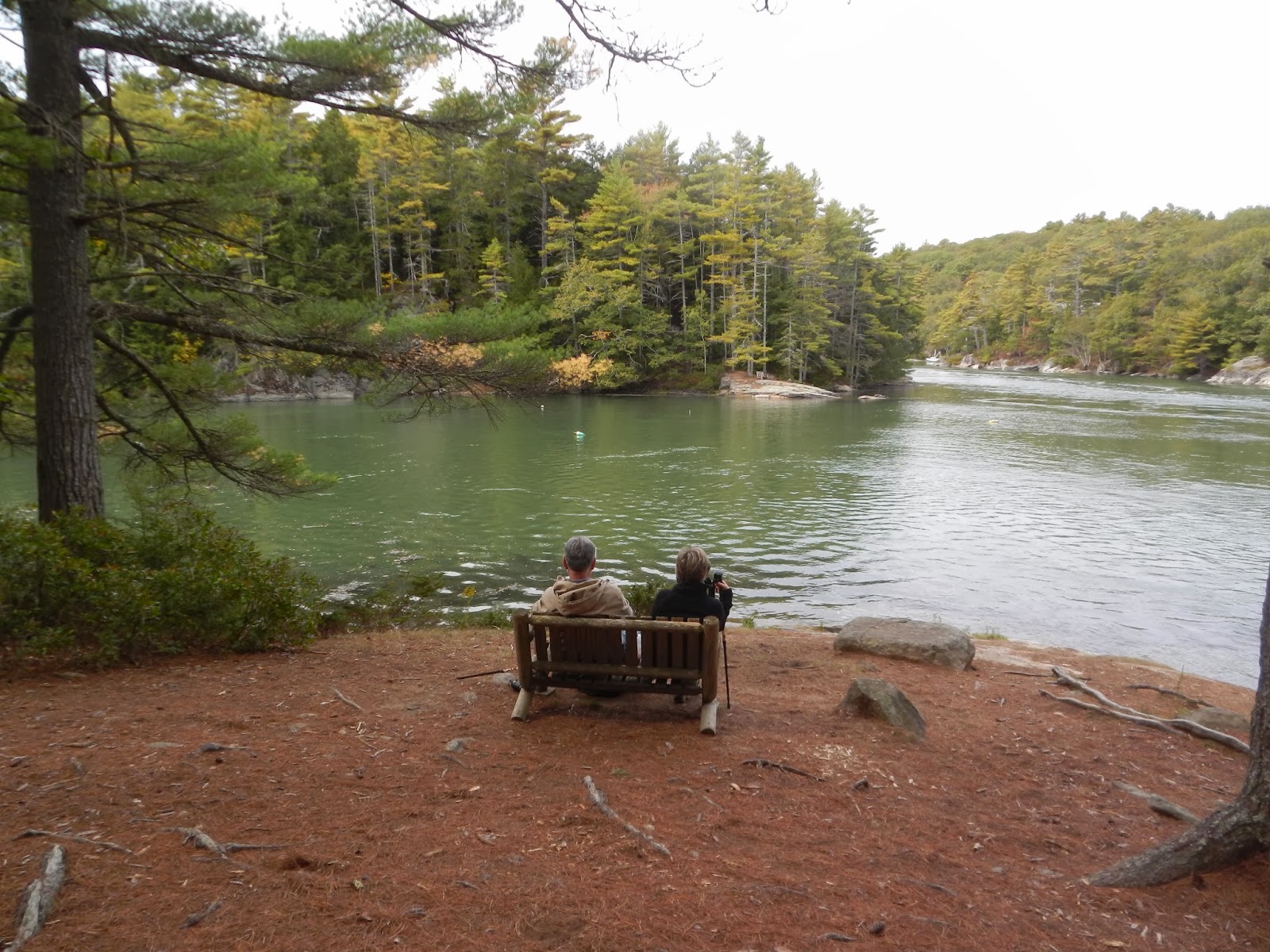
The answer?  D of course.  Sunday we packed some snacks and headed over to Ovens Mouth in Boothbay.  It was lovely, and warm, just like the rest of the fall has been. Too warm and lovely, it might seem.  Weather, of course, shouldn't be confused with climate.  Weather is the exact condition at a particular moment, whereas climate is more like the average weather, or weather trend.  So having one nice day in October (in Maine) doesn't mean that climate is changing and things are getting warmer.  (Of course, neither does a blizzard in March mean climate is not changing.)  But the trends show that warmer days are more common; the Gulf of Maine is getting warmer; and atmospheric carbon has reached frightening levels. This suggests that maybe the weather last weekend wasn't an unusual warm day, but was part of a warming climate in Maine.

Climate change in the Gulf of Maine isn't an abstraction -- it's real, and it affects real people and organisms in the ecosystem. Last week I went to the RARGOM (Regional Association for Research in the Gulf of Maine) Annual Science Meeting, which asked the question "The 2012 Gulf of Maine heatwave: anomalous year or the new normal?"

Short answer?  Maybe, especially in the long run.

Long answer?

Consider:  The Gulf of Maine was ~3° C warmer than usual, the most intense heat wave in at least the past 30 years.  High temps were around for a long time, and spread over a large geographic extent.  This may have been the result of warm, humid air; the jet stream pattern; or larger systems like the North Atlantic Oscillation and ocean circulation.

Consider:  The phytoplankton bloom was very early.  The bloom may have occurred too early for the energy stored in plankton to be shifted up the food chain.

Consider:  Many southern fish were found in the Gulf of Maine.  Butterfish and blue runner, normally a rarity in the Gulf of Maine, were common.  Apparently the trend continues into 2013 (mahi mahi in Rhode Island?  Surely not.)

Consider:  Lobsters.  In 2012, lobsters responded to warm temperatures by migrating shoreward and molting ~3 weeks early.  That might seem like a good thing for lobstermen, as these processes are linked with higher catches.  In June and July, catches rose by 15 million pounds -- but the price fishermen got dropped 40%, to just $2.63 a pound.  It was the great lobster stampede, as too much product came ashore; swamping processing plants in Maine and in Canada (where Canadian fishermen tried to blockade plants).  

Consider:  Puffins bring their chicks any small fish in the water column, which in 2013 wasn't the white hake and herring they usually rely on, but were things like butterfish and other southern species.  Butterfish are to fat to fit down a chick's beak, and they died in large numbers, surrounded by piles of small fish they just couldn't eat.  Apparently this year moon fish are being brought in by seabirds, another mismatch between forage fish and beak size.

Consider:  Razorbills, a relative of the puffin, were found in large numbers in Florida and the Gulf of Mexico following the 2012 summer.  They were probably displaced by lingering warm waters (and a resulting lack of bait fish) in their normal winter grounds.  Many of these birds seemed to die on their way back to Maine for the breeding season, perhaps from storms they could not weather given poor body condition.  In Cape Cod alone, 264 were found dead (many emaciated) on the beaches, and since they are an offshore bird, any showing up on a beach represent many more dying offshore. 

All this leaves the ocean lover with a lot to think about.  Even if 2012 was simply a hot year and an anomaly there is good evidence that the Gulf of Maine is warming at ~0.01° a year, or even more recently.  By 2050, Calanus finmarchicus, the base of the pelagic food chain, is expected to be excluded from the area. (In fact, there are reports of very low Calanus densities this year, along with very low numbers of right whales, which feed on Calanus exclusively.)  What the future holds is a mystery that at times keeps me awake at night.  Maine is the last outpost of cold northern waters, and we are likely to see great change come our way -- soon.

I know what some of you are saying:  Bring back the lobster roll posts!  Show me a nice coastal hike!  How about a picture of a whale?  Unfortunately, loving the ocean means dealing with the impacts of humans.  Climate change can make all the other problems the oceans face moot, so it's something we all need to talk about and connect ourselves to.  We live now, when the impacts of climate change are hitting us over the head, and ignoring them does us no good.  So if you don't like to think about climate change; drive less, be efficient in your use of electricity, eat less meat, and buy less crap.  That way you can know you're reducing your own contribution to the problem.

Now about that hike:

BBRT makes a great point here.  Land trusts are worth joining.

It's hard to see here, but the tidal currents were causing standing waves out there.

A quiet place for contemplation

Ovens Mouth is another terrific Boothbay Region Land Trust property.  It's dog friendly with some spectacular views of the tidal Ovens Mouth River.  The hike takes you on two peninsulas, connected by a beautifully crafted bridge (the perfect place for a picnic).  Cedar forests, salt marshes, and upland forest all string along the trail.  Pair your hike with a trip in to Boothbay for a bite to eat and you've got a great day trip.  We like to go on to Newcastle or Damariscotta for lunch when we go -- the Newcastle Publick House and the King Eider Pub both are favorites.

The bridge
Thinking deep thoughts?
To Get There:  Drive south on Rt 27 (from US1).  Just past the campground and train museum you'll turn right onto Adams Pond Road (turn at the Cottage Connection).  Go 0.1 miles and turn right onto Dover Road.  Go ~2.5 miles (a beautiful drive) and you'll see a sign for the preserve; I like to park at the eastern lot.